
Lavas and Sediments at St Cyrus, E Scotland
The Devonian period in Scotland was one of abundant volcanic activity. In many places, there is the opportunity to see evidence of interesting interactions between products of volcanoes (mainly andesite and basalt lavas) and the various sediments that were being laid down at the time. There are some excellent outcrops at St Cyrus to the north of Montrose and at Boddin Point - Lunan Bay to the south of Montrose. Please check out my blog on the latter locality.
https://www.ogilviegeoscience.com/blog/lava-and-sediments-lunan-bay
Coastal outcrops at St Cyrus
St Cyrus beach and nature reserve is about a 50 minute drive south of Aberdeen in NE Scotland. From the A92 southwards, take a left turn (signposted) down to the beach area, passing Steptoe’s junk yard. Coming from the south, you’ll cross the (single lane) bridge over the North Esk River and then take a sharpish right turn down to the beach access road. The car park for the nature reserve is at the end of this road.
The outcrops can be reached by taking a path along the back of the beach. One of the first outcrops (shown below) is just beyond the bothy at the start of the section [1]. The lavas (mainly andesite and basalt) are part of the Montrose Volcanic Formation (also found at Lunan Bay) and have likely come from a volcano somewhere to the south of Montrose sometime during the Lower Devonian.
It looks like the (reddish) sandstones and siltstones have filled irregular patches/hollows in the lava flows where early sediment has been eroded out. Here we see a channel between 2 lobes of lava that is filled with sediments - these are quite quartz and mica rich being derived from surrounding sediments and not from volcanoes [1]. The sediments have some nice sedimentary structures including a simple plane bedding (lamination) and also ripples - some of these have been disturbed (some small folds) by air/water escape in the soft unconsolidated sediments.
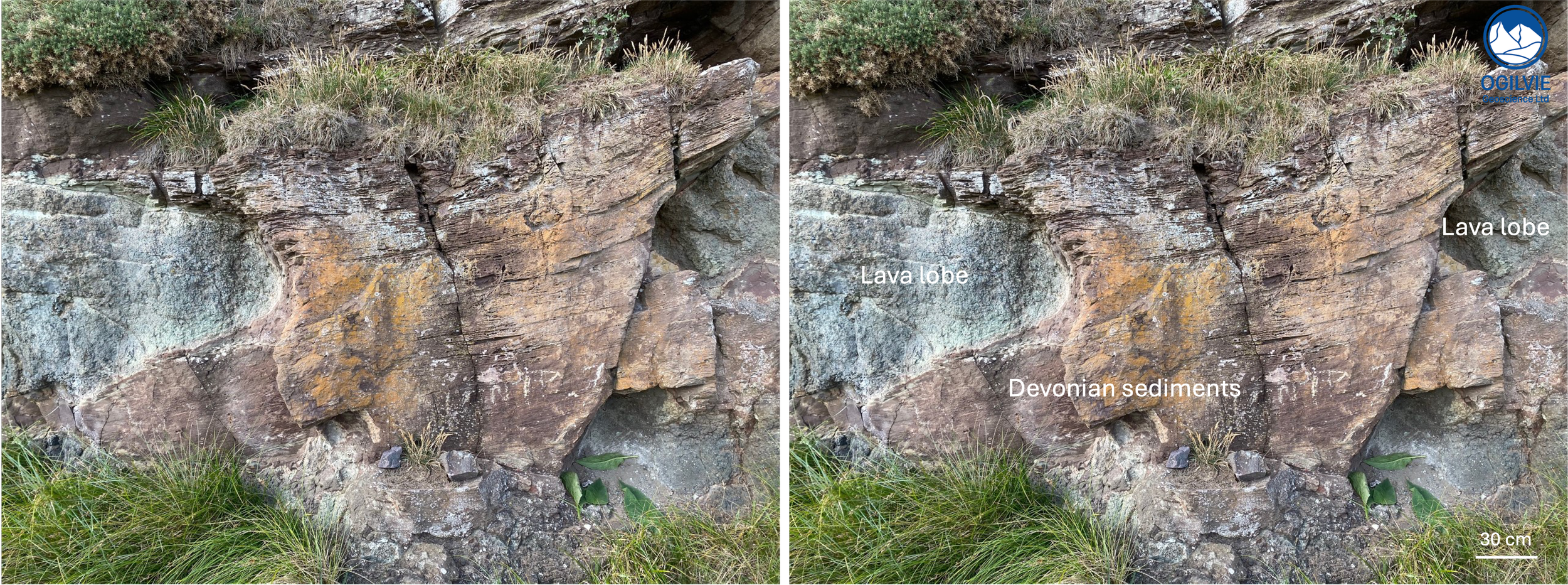
View of a sediment filled channel between 2 lobes of lava.
This particular relationship between lavas and sediments (amongst others) is shown in the sketch below.
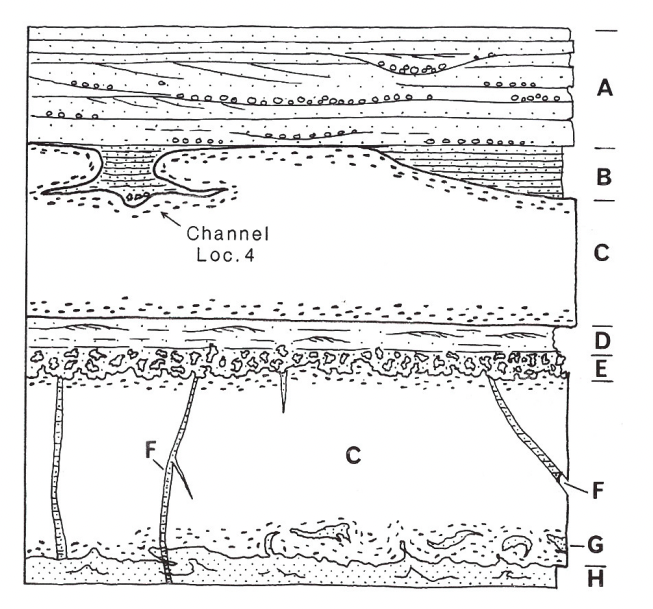
Drawing from Nigel Trewin’s fieldguide [1]
Plenty of joints and faults here - just to the right of the black lab (below left) is a fracture swarm where there is a high concentration of joints. The sediments within the lava (below right) can be used as a marker horizon for what looks like a reverse fault. Note the numerous holes or vesicles in the lava on both sides of this fault. The lavas have been exposed to weathering and erosion during the Devonian period.
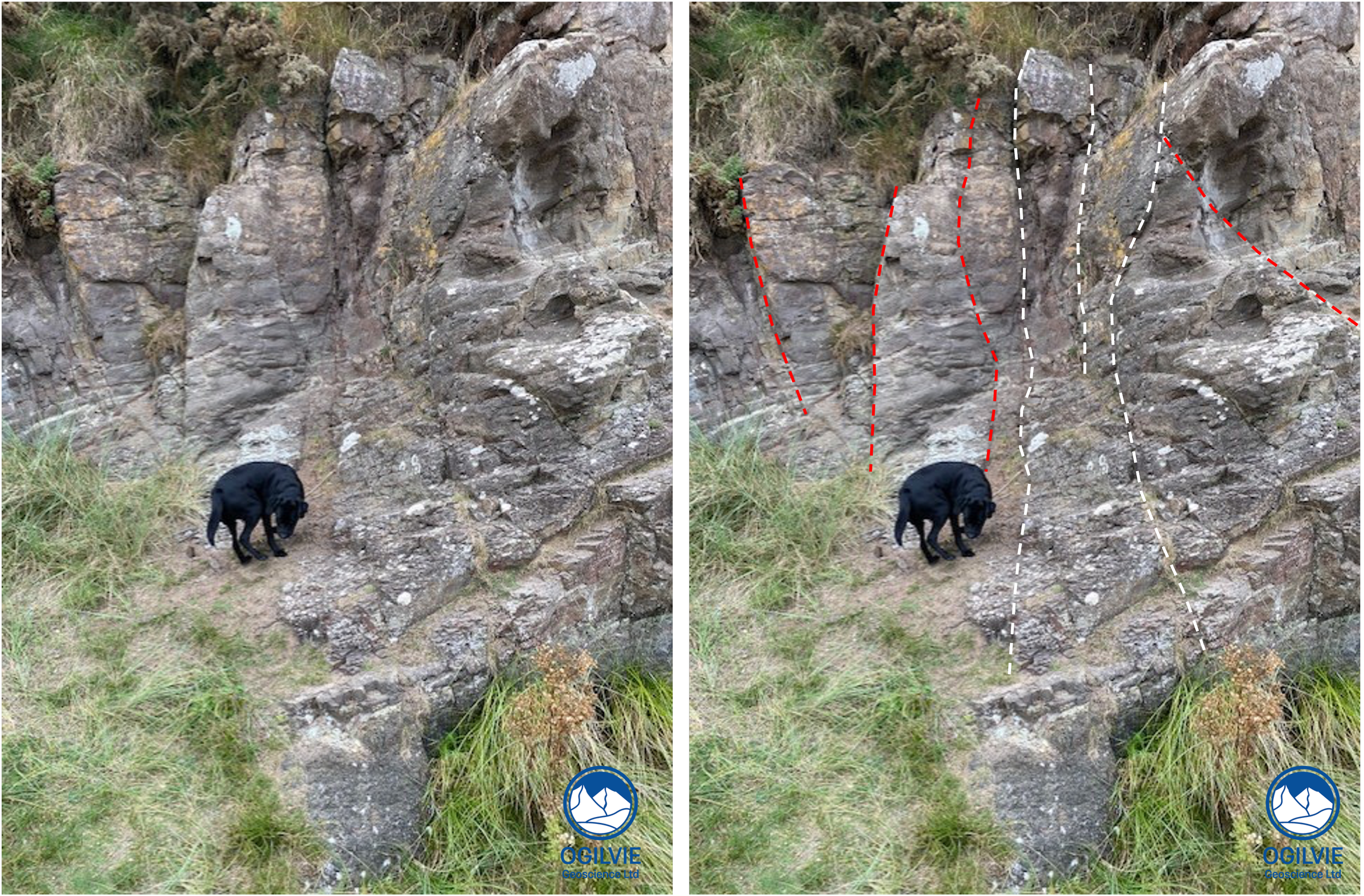
Fracture swarm to the right of the black lab
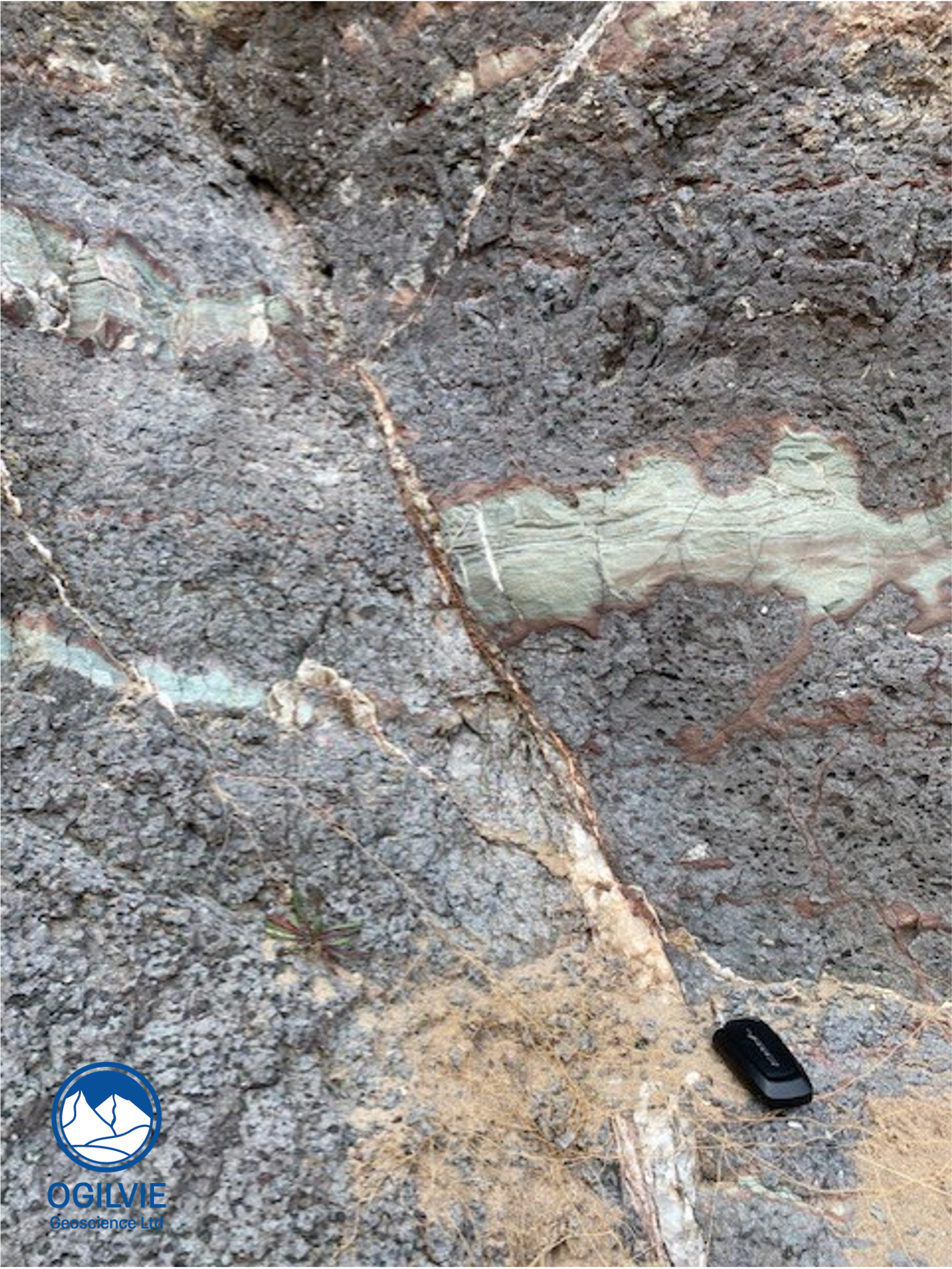
Reverse fault with sedimentary layer as a marker bed