
Lava and sediments, Lunan Bay

Looking north along the sands of Lunan Bay towards the North Headland
Lunan Bay is one of largest and most scenic beaches on the east coast of Scotland and is located just south of the town of Montrose. It is more known for the agates that have been eroded out of the surrounding Devonian age lavas, than the lavas themselves. These can be found in rock pools at the north and south headlands and also amongst sparse pebble stringers along the beach sands, parallel to the coast.
When you come out onto the beach from the car park, it is a faster walk to the north headland than to the rock outcrops on the south side of the bay. You can walk in and out of the caves seen below - access is very good - and observe some of the very beautiful textures in the lavas that belong to the Montrose volcanic formation. Lavas from this formation also occur a bit further north at Boddin Point.
The reddish coloured lavas often contain rafts of a distinctive greenish-grey coloured, fine grained sedimentary rock.
There are also many large crystals of olivine in the lava (basalt ?) giving the rock a very distinctive spotted character.
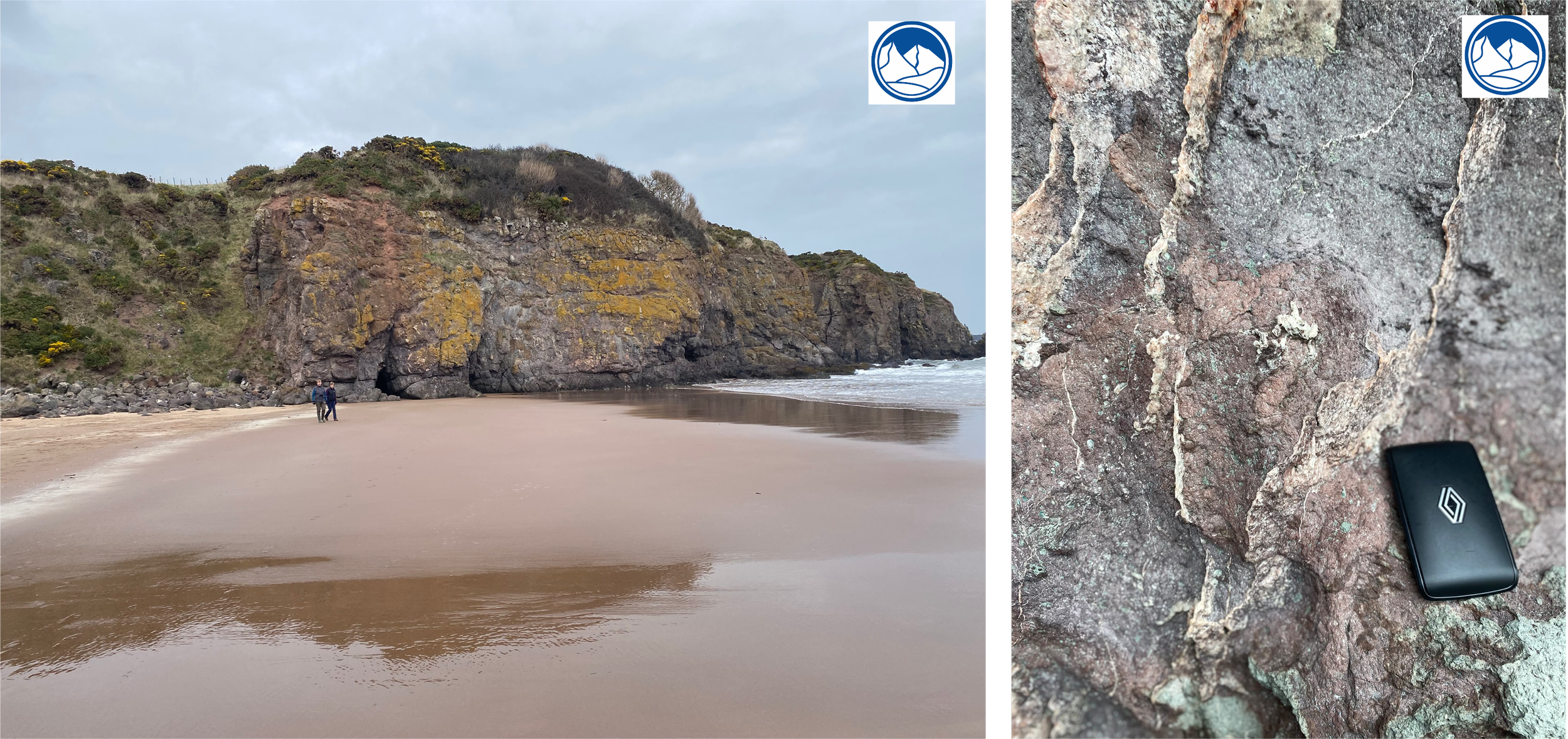
North headlands of Lunan Bay and (right) close up of the lavas with rafts of green-grey coloured fine grained sedimentary rocks.
One of our best finds the day that we went there was this rather attractive boulder on the beach just next to the lava outcrops at the north end of the Lunan Bay. The combination of reddish-brown lavas and distinctive greenish-grey sedimentary rocks is quite striking. We can describe these as rafts of sediment within the lava - the sediments seem to have been incorporated into the lavas. This association of lavas and sediments is quite common at nearby St Cyrus bay. In fact there is an excellent description of the lavas and sediments at St Cyrus by Aberdeen University [1].
There are other examples of this type of geology at Boddin Point - see photo below (right) and also a blog written on this area…
https://www.ogilviegeoscience.com/blog/limestones-at-boddin-point
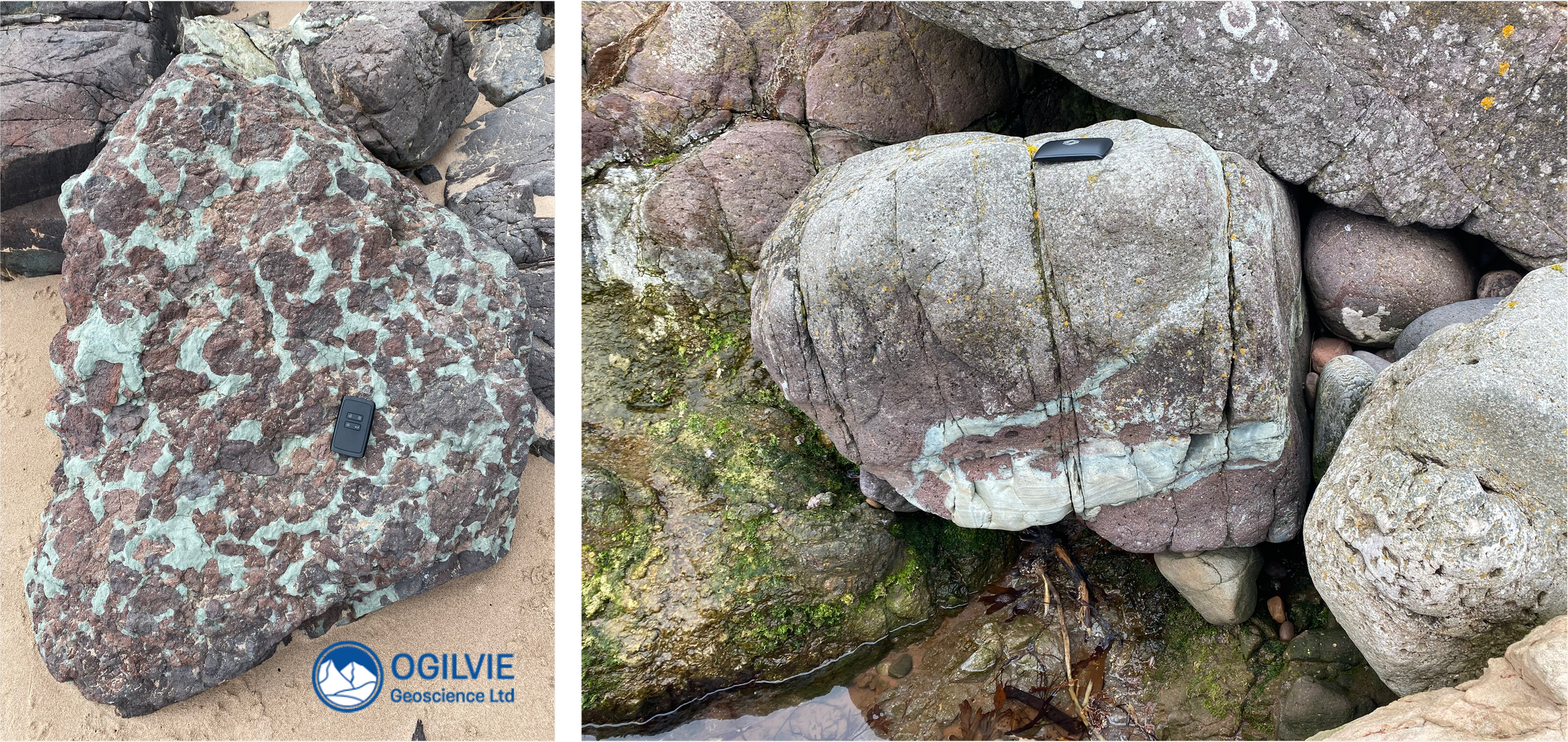
Stunning boulder of lavas mixed with sediments at North end of Lunan Bay and (right) another example of mixed lava and the distinctive green coloured fine sediment; this time from Boddin Point (which is further North of Lunan)
A mixture of lavas and sediments
The green coloured, fine grained sediments often have a well defined lamination (above right)- sometimes this is horizontal and other times it is cross bedded. The green colour is likely a result of a high ash derived content [1]. These sediments tend to occur in association with lavas, having been incorporated into the lava flows. Work suggests that these green coloured sediments are reworked ash-fall tuff deposits and the occurrence of chlorophycean algae point to a lacustrine environment [1].
Hole, M, Jolley, D, Hartley, A, Leleu, S, John, N, Ball, M. 2013. Lava-sediment interactions in an Old Red Sandstone basin, NE Scotland. Journal of the Geological Society, v170, P641 - 655.