
Fracture Swarms Explained
What are fracture swarms ?
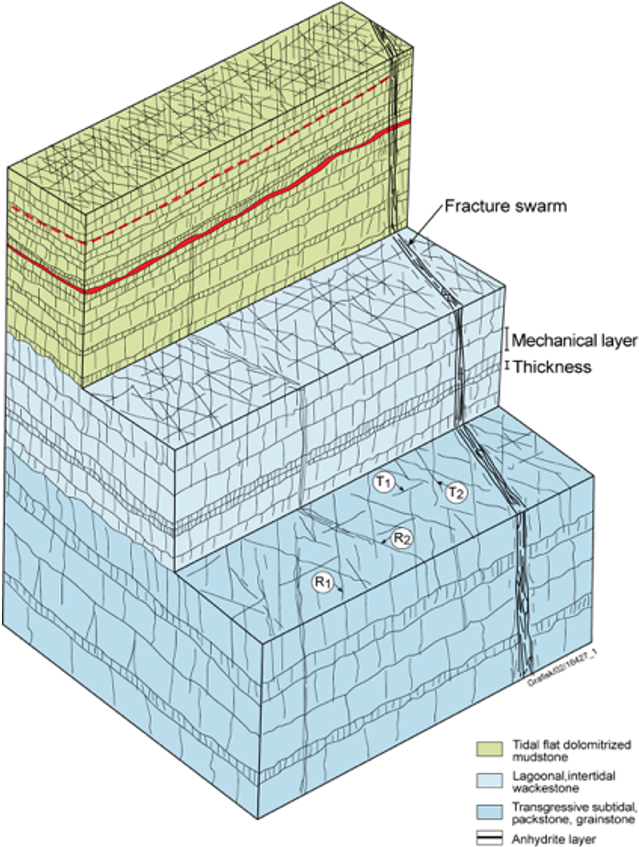
Strata-bound fractures and swarms in the Bibi Hakimeh oil field (Iran); an ideal shallowing up cycle of the Asmari Formation with a typical fracture pattern in a forelimb of the anticline [1]
Fracture swarms are concentrated zones of open fractures with significant aperture but lacking any major offsets of marker horizons. It may also be a single fracture with extreme aperture e.g., due to extensive dissolution of a carbonate matrix rock. They are usually more through going than diffuse fractures, and not confined to individual beds These intervals of high fracture density are unlikely to be preserved in rock core from an oil field - they may appear as rubble zones or are not recovered at all.
Sometimes these are called fracture corridors.
What do they look like in the field in rock outcrops ?
Regions of rock outcrops which contain more fractures than are present outside of these zones. Usually these fractures are steep or vertical.
The view below shows at least 3 fracture swarms running vertical (up and down) through a dolomite cliff section along a coastal section- Marsden Bay, NE England. These rocks represent carbonate platforms formed during the Permian period - specifically during the Zechstein marine phase. The fractures outside of the swarms can be called background fractures as are more evenly distributed (less concetrated) throughout the cliff section. As we look up and down the cliff we will see that the background fracture density will vary with what is called mechanical stratigraphy. In particular, certain rocks (often those that are more brittle) will contain more fractures and bed thickness controls fracture density - thinner beds tend to have more fractures than thick beds.
The next photograph shows a cliff section along Aberdeen’s coastal path - of highly deformed metasediments of Dalradian age. Part of this deformation is a vertical fracture swarm in the middle of the view. On the left of this is an active landslide of more recent (glacial) material down into the adjacent gully.
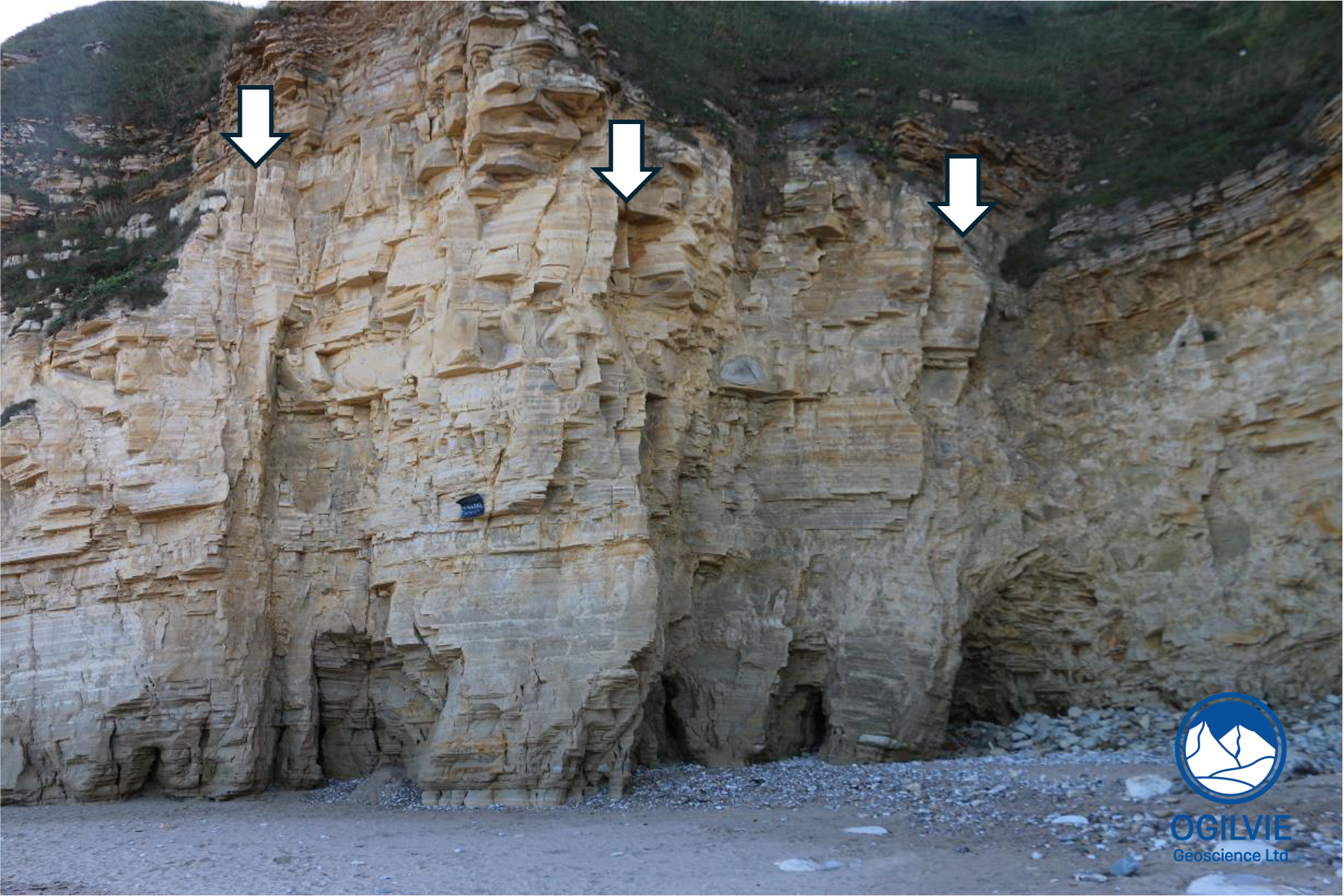
Fracture swarms running obliquely into the cliff made of dolomite. Zechstein Carbonate platforms, Marsden Bay, NE England. There is also background fracturing (which is often bed-bound).
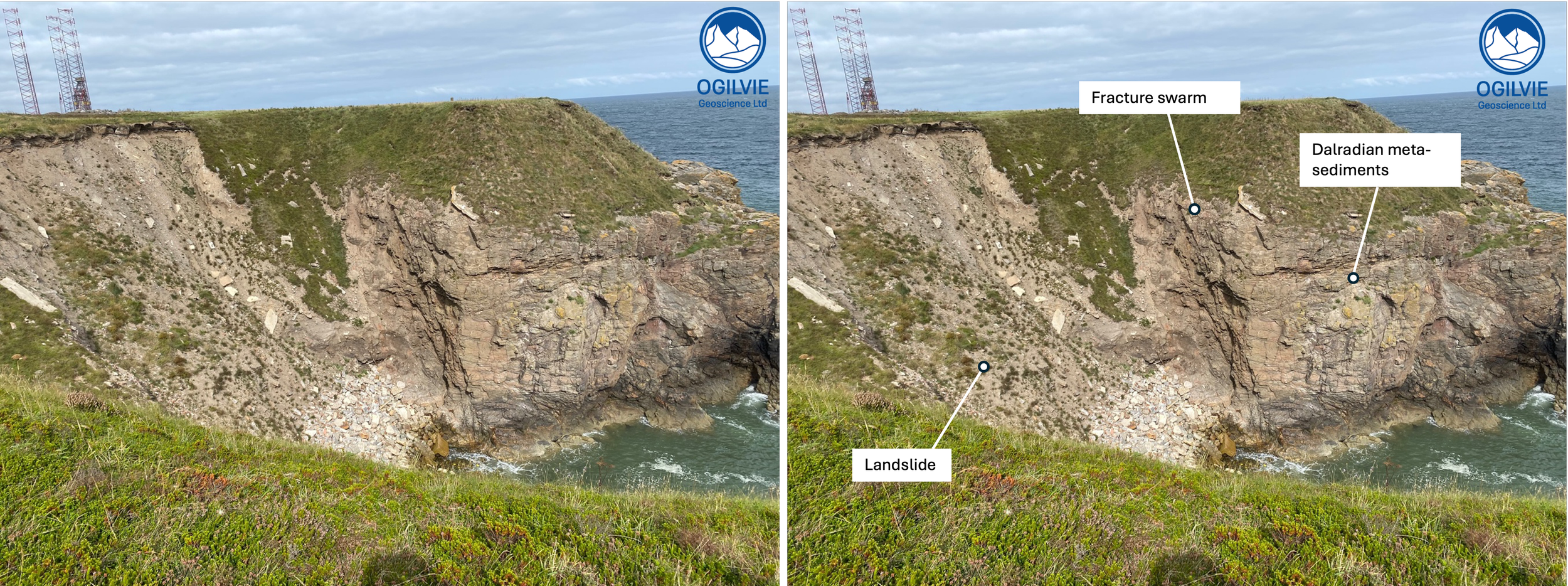
Fracture swarm in Dalradian metasediments along Aberdeen coastal path, NE Scotland. Just over the back to the left is Aberdeen’s newest harbour at Girdleness.
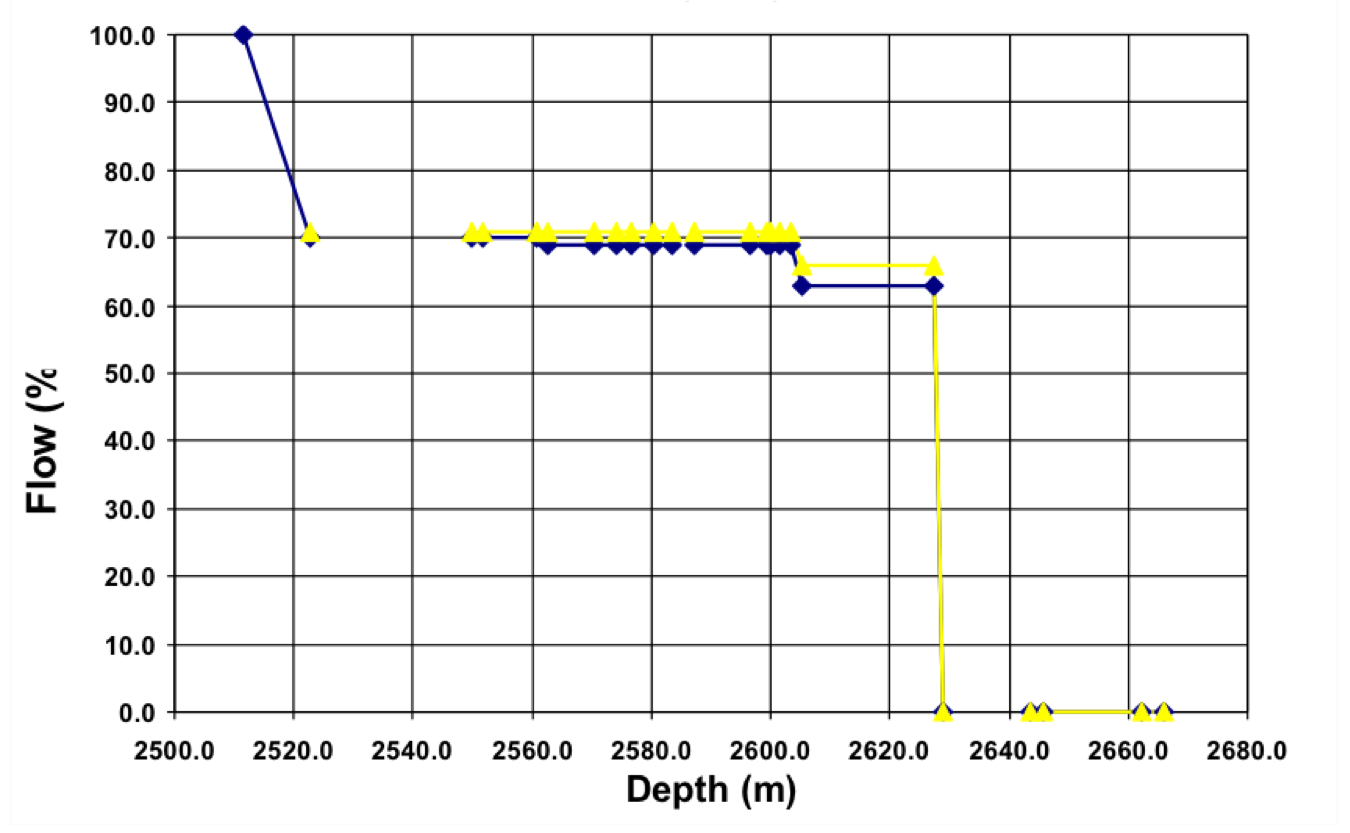
Result from a production log test (PLT) - there are 2 test results (yellow and blue data) for the same well showing that most of the flow occurs over a thin interval.
What about in the subsurface, in an oil, gas or perhaps geothermal field ?
In the subsurface, these may be difficult to interpret from static data (seismic, image logs etc) data but it’s well worth checking out dynamic data. High influxes of flow over short intervals on a production log test (PLT) can indicate fracture swarms. It may be that only a few large fractures or swarms control production - obvious, if for example, the PLT log shows that an interval of less than 1 m contributes to > 80 % of the production at a flow of 18 000 bbl/day.
I’ve come across seismic scale faults that contribute little/not at all to flow; it is the swarms (that are detectable on image logs and PLTs for example) that control the flow.
Mud loss data is cheap (free !) and a very good fracture indicator. Continuous, spurt (small) losses can indicate background or diffuse fractures (joints), whereas more infrequent, larger losses can be related to fracture swarms.
Its also worth checking out well test data - in particular the boundary phase, as linear flow behaviour may be evident.
[1] O. P. Wennberg, M. Azizzadeh, E. Blanc, P. Brockbank, K.B. Lyslo, S. Ogilvie, L.D. Salem & T. Svånå. 2005. Use of outcrop analogues in fractured reservoir characterization – an example from the Dezful Embayment, SW-Iran. Extended abstract for EAGE 67th Conference & Exhibition — Madrid, Spain, 13 - 16 June 2005.