
Clashach Quarry, Hopeman, Morayshire
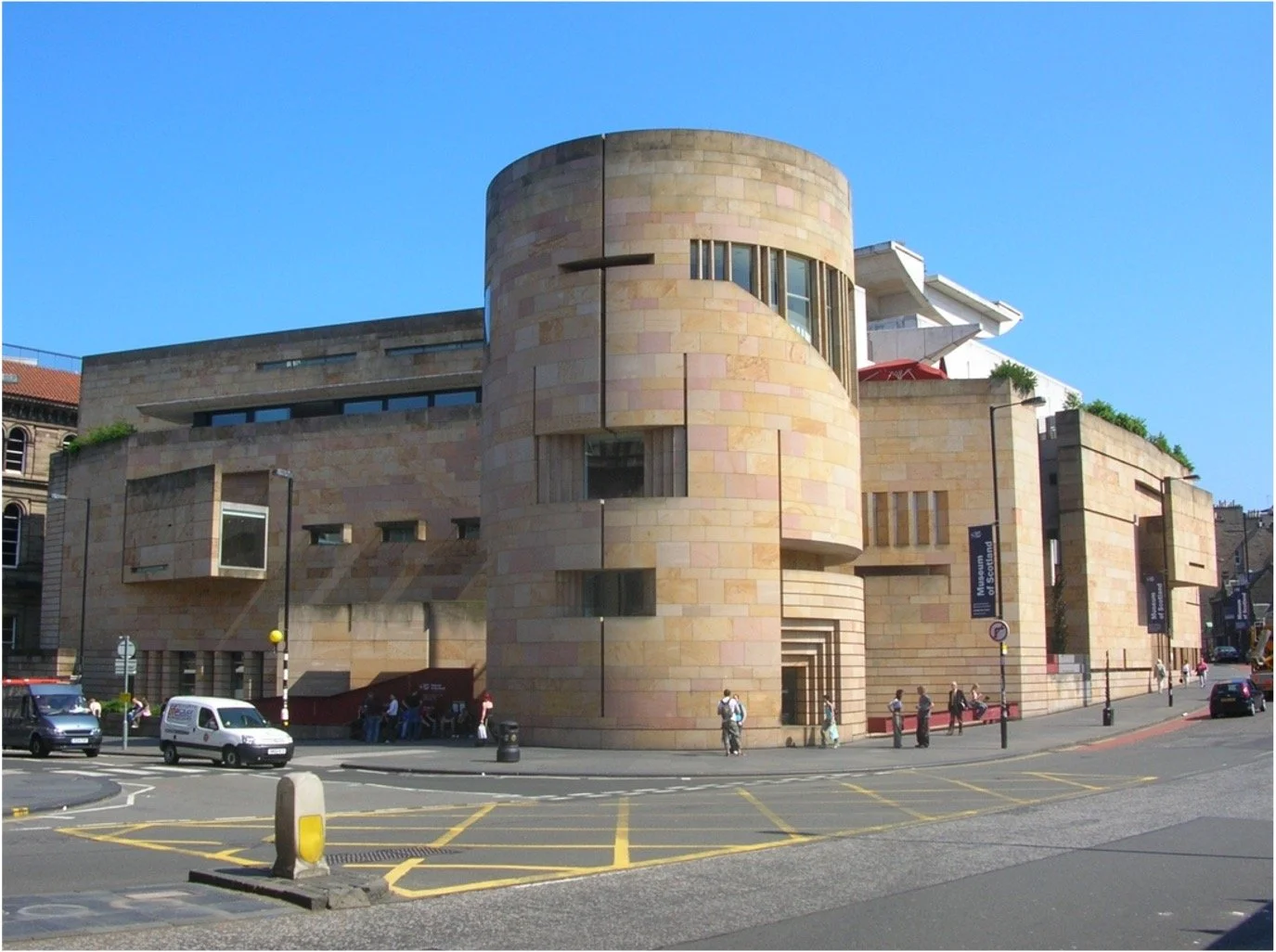
National museum of Scotland in Edinburgh which has cladding from Clashach Quarry
https://en.wikipedia.org/wiki/National_Museum_of_Scotland#/media/File:Museum_of_Scotland.jpg
I can go to a rock outcrop or geological locality (what feels like) 100s of time and see different things - sometimes that’s helped by erosion, shifting sands etc exposing new geological features. Other times, its just having a look with a fresh pair of eyes (often belonging to other people).
Working quarries often have the upper hand as new material is continually being exposed. On the downside, access may not be that easy and it can depend upon whether or not the operator working the quarry will cooperate with interested folks such as geologists.
Clashach Quarry a working quarry in the Hopeman Sandstone
Located roughly half way along this coastal outcrop (just outside of Hopeman, Morayshire), Clashach Quarry has provided a very durable, pale yellow-orange sandstone for many building projects in Scotland and beyond. It is likely that this sandstone is locally cemented by quartz giving it an almost sugary (meta-quartzite) texture in hand specimen.
One of the best known cases is the use of this sandstone as cladding material for the National Museum of Scotland in Edinburgh. It has likely also been used for historical buildings such as the nearby Duffus castle. Recently, I came across a block of the Clashach stone near an outhouse in the grounds of Pluscarden Abbey (below right)- it looks like it’s been used for some projects there.
Access to the quarry
Clashach is a working quarry so permission is required. In fact, you can no longer take your car up the rough track that takes trucks up to the quarry from the main Lossiemouth-Hopeman road. You have to either get dropped off there or maybe park a single car there and walk up towards the quarry. Once at the top of the track it’s possible to bypass the quarry (by foot) and to drop down into Clashach cove to study the Clashach fault which is one of the most popular geological spots along this coastline. Another way to access to bay and the fault locality is by the coastal path east of Hopeman village.
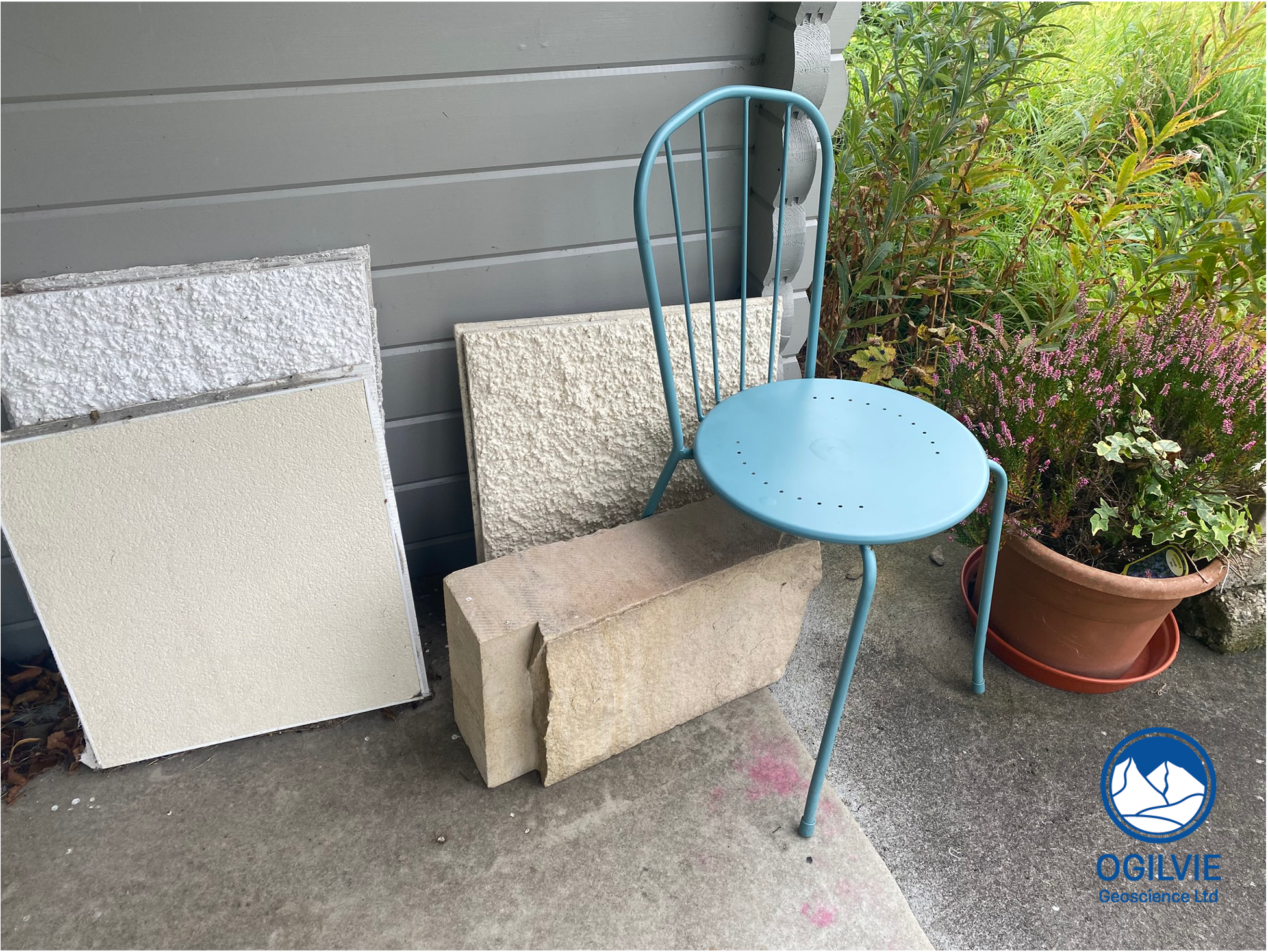
Block of what looks like Clashach Sandstone below a chair, near a new outhouse at Pluscarden Abbey, Morayshire.
Reptile footprints
The Hopeman sandstone is well known for reptile footprints (and associated trackways and tail marks) from the Permian period. The various quarries along the coastline have long been a productive source of reptile finds. Masonhaugh, an abandoned quarry (to the west of Hopeman) now has an information board up on the old railway path showcasing the quarry as a site of reptile finds. Around 25 years ago, Scottish Natural Heritage organised a display of Clashach slabs at the entrance of Clashach quarry with reptile trackways and other features such as tail drag marks. This worked well as there was no need to go into the quarry itself - when I visited a few years back it was very overgrown which is a shame.
Perhaps the most significant find was in 1997 (by a quarry worker) a mould of a dicynodont skull. A model was built using CT scanning. It has dated the Hopeman Sandstone as Late Permian/Early Triassic. This together with some of the trackways and other markings are held in the Elgin museum.
More unusual features from the quarry
I got hold of this piece of Hopeman sandstone with some iron mineralisation at an Aberdeen Geological Society rock auction around 25 years ago. The label says that it comes from Clashach quarry but the sandstone (part) looks coarser grained and more friable than the Clashach sandstones used for building. There’s also some deformation bands (white vein like features) in the sandstone bit. The sample was described as a travertine-like deposit with a higher than usual amount of iron hydroxide. I think that it’s more likely that it came from Clashach Cove seaward of the quarry as the sandstone looks similar there and there are copious fault rocks in that area.
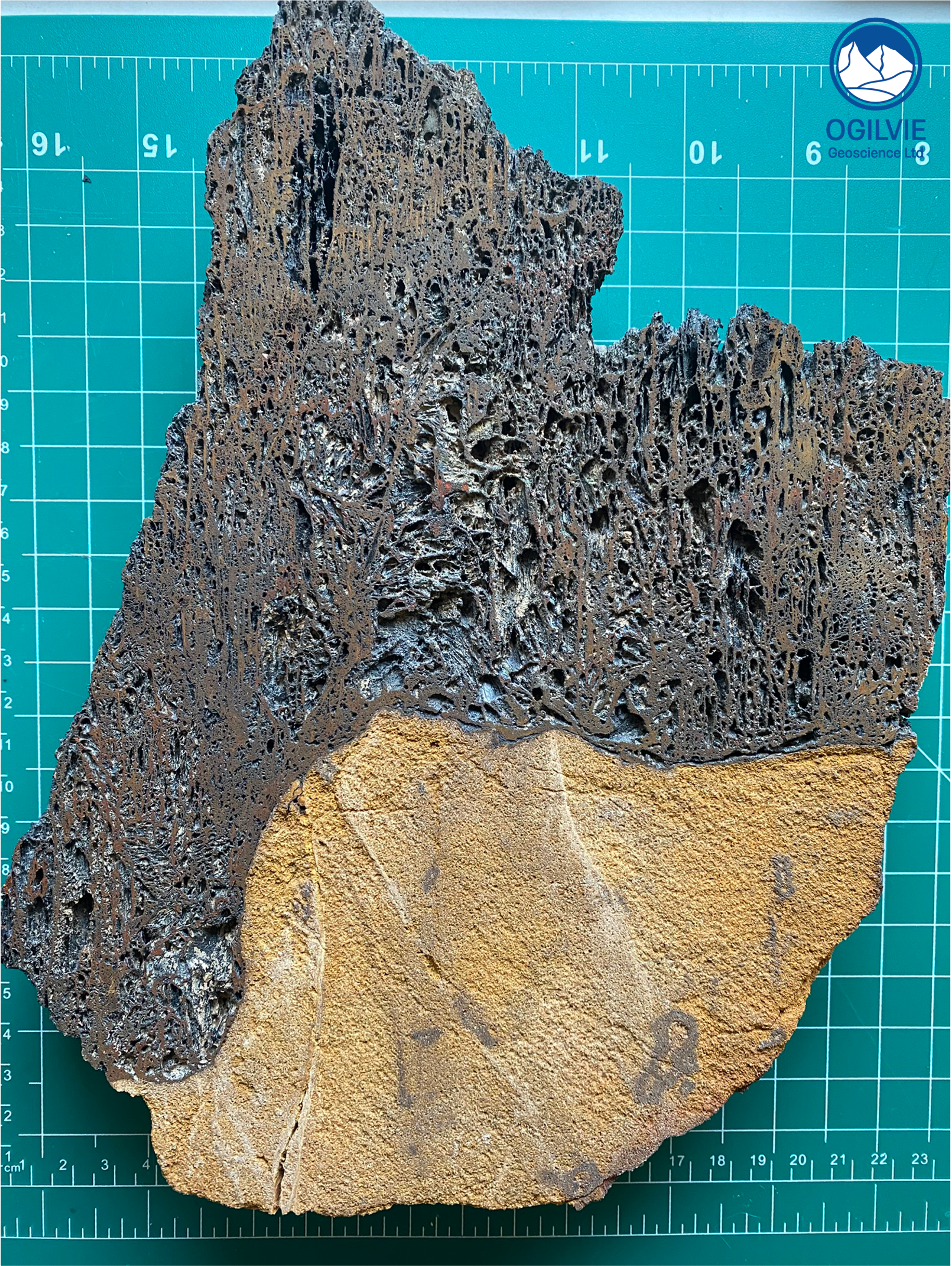

Described as a travertine like deposit from a fault zone in Clashach Quarry.
Other coastal features
Gypsies cave and other caves in the Clashach cove area are raised beach sea caves which contain various markings such as ship artwork/graffiti from the 18th/19th centuries. There was also a small harbour to export stone but this was not used after the advent of the railway line (early 1900s ?).