
Soft sediment folds, Kingsbarns, Fife, Scotland
Location in Scotland
On the Fife coast, just South of St Andrews. There is a nice and simple guide from called the Kingsbarns Geological Trail supported by geoheritage Scotland and Fife Council that I followed when I walked a part of the Fife Coastal Path in March 2026. The guide below contains a map and the basic route…
Geology guide to Kingsbarns area along Fife Coastal Path
The rock outcrops are Carboniferous in age. There are many geological features to see here as detailed in the guide, but our focus in this blog is upon the soft sediment folds and contortions that are found in the Carboniferous sandstones.
At what depths do soft-sediment folds form ?
We mostly think about folds as having formed during to the Earth’s tectonic forces during a squeezing or compression episode. These types of folds (often called tectonic folds) can form many kilometres down into the Earth’s crust as the crust becomes quite ductile (easy to bend) at this depths.
Some folds do form at shallow depths and cause deformation of unconsolidated sediments. Therefore, they are often called soft sediment folds.
There are spectacular examples of those in the Hopeman Sandstone (Moray coast, Scotland) that formed soon after deposition. These de-watering and air escape structures were extensively studied by Prof. Ken W. Glennie in the 1980s..
https://www.ogilviegeoscience.com/blog/ken-glennie-event
Many of these form soon after deposition when the sediments and loose and unconsolidated - as opposed to millions of years after deposition as is the case with tectonic folds. Possibilites are gravity controlled soft sediment deformation e.g., on unstable delta slopes or in the toe area of landslides.
Sediments can become fluidised just after burial - this can create folds and contortions related to various intrusions such as sandstone dikes and also mud diapirs. Many of these can also be found in the Hopeman Sandstone. Earthquakes, gravity loading and maybe meteorite events can be the trigger.
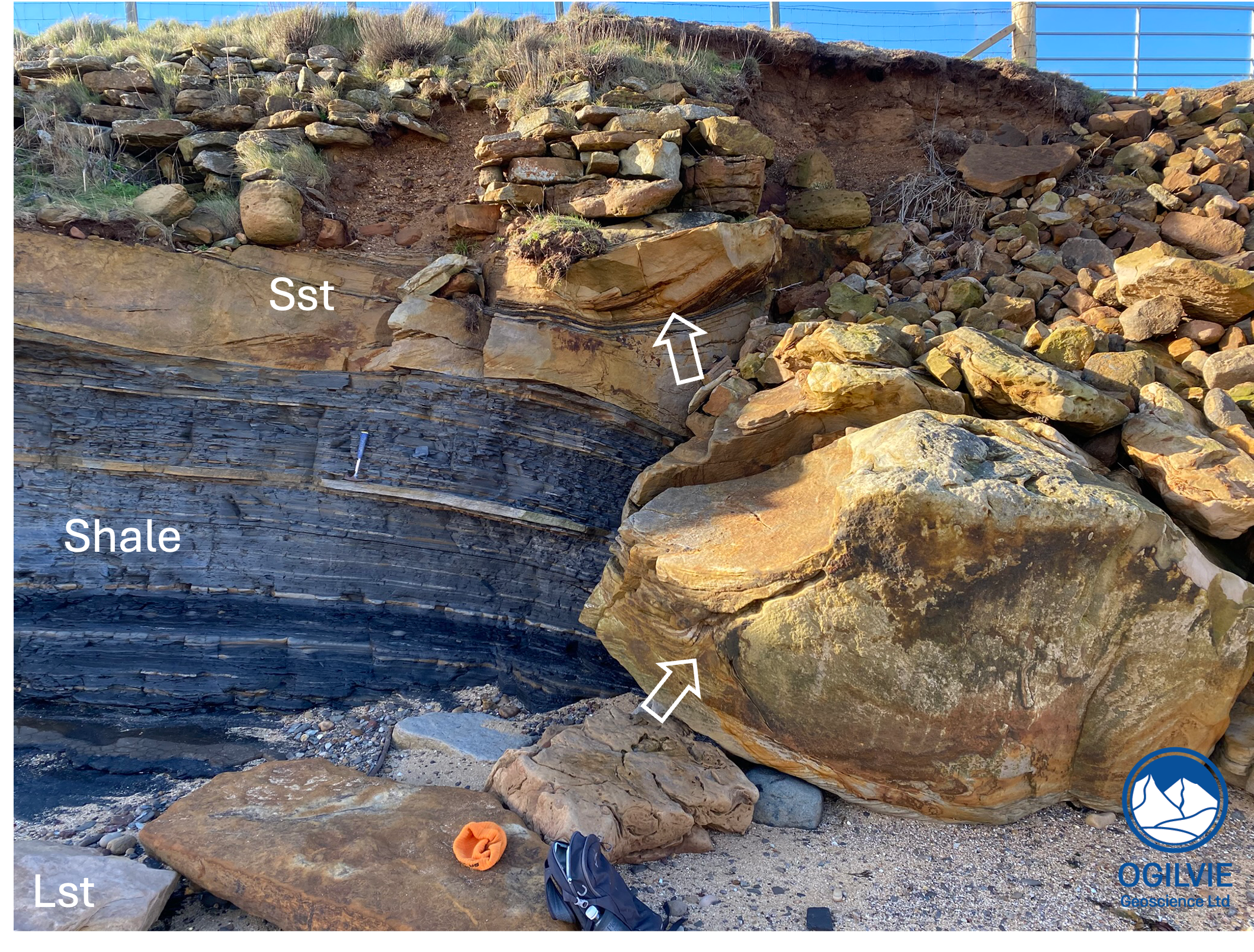
Small cliff at Babbet Ness, just N of Kinsgbarns, Fife Coast.
The sandstone at the top of this succession has many folds and contortions. The block on the right has collapsed and fallen downwards.
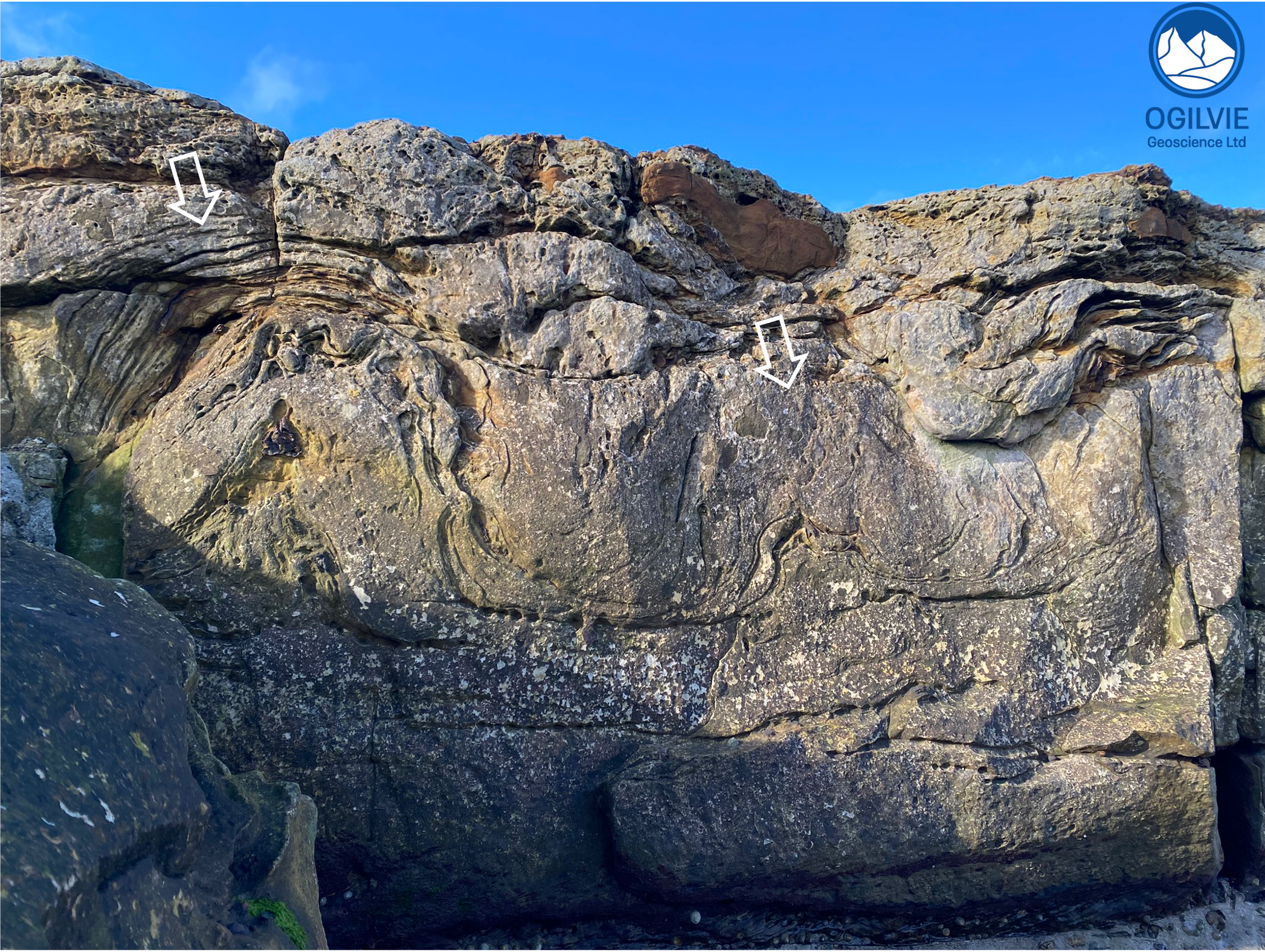
More folds at Babbet Ness - further along to right hand side (towards sea) from photo above - even within the fold on the left is a directed upwards/funnel like structure
Key features of soft sediment folds compared to those formed in the plastic regime..
Form due to gravitational instabilities and maybe de-watering in the brittle Upper Crust or close to the surface as opposed to at considerable depths (the plastic regime).
Often non-cylindrical
Range in fold style from gentle to isoclinal to upright to recumbent
Often confined to single layers where layers above and below untouched
Often “directed upwards” sometimes funnel-like features such as the example from Kingsbarns opposite..
For more details there is a nice section in Fossen’s structural geology textbook P277 - 278.
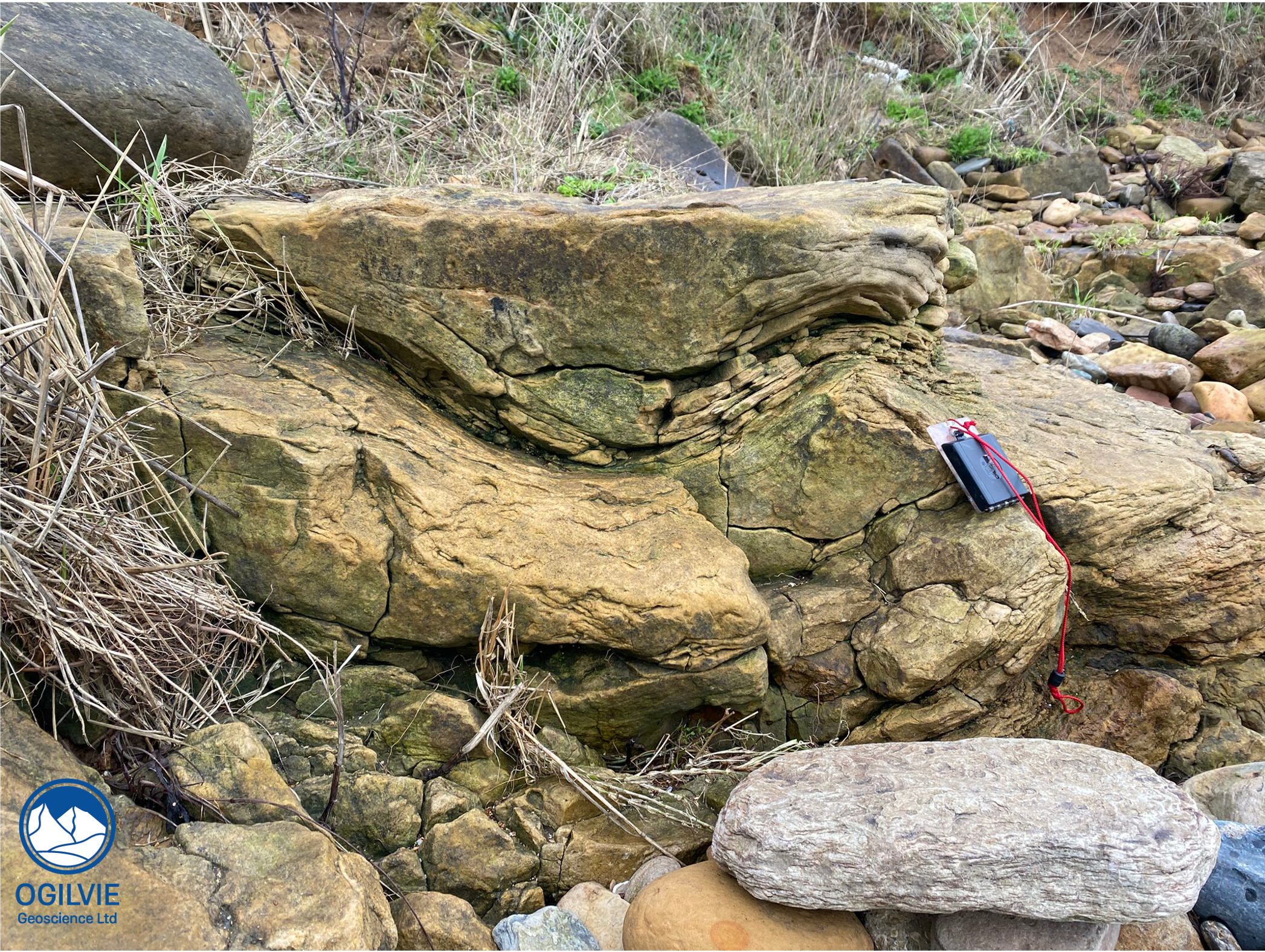
Soft sediment fold near Kingsbarns, Fife, along the Fife Coastal Path