
Clashach Cove Fault, Moray Coast
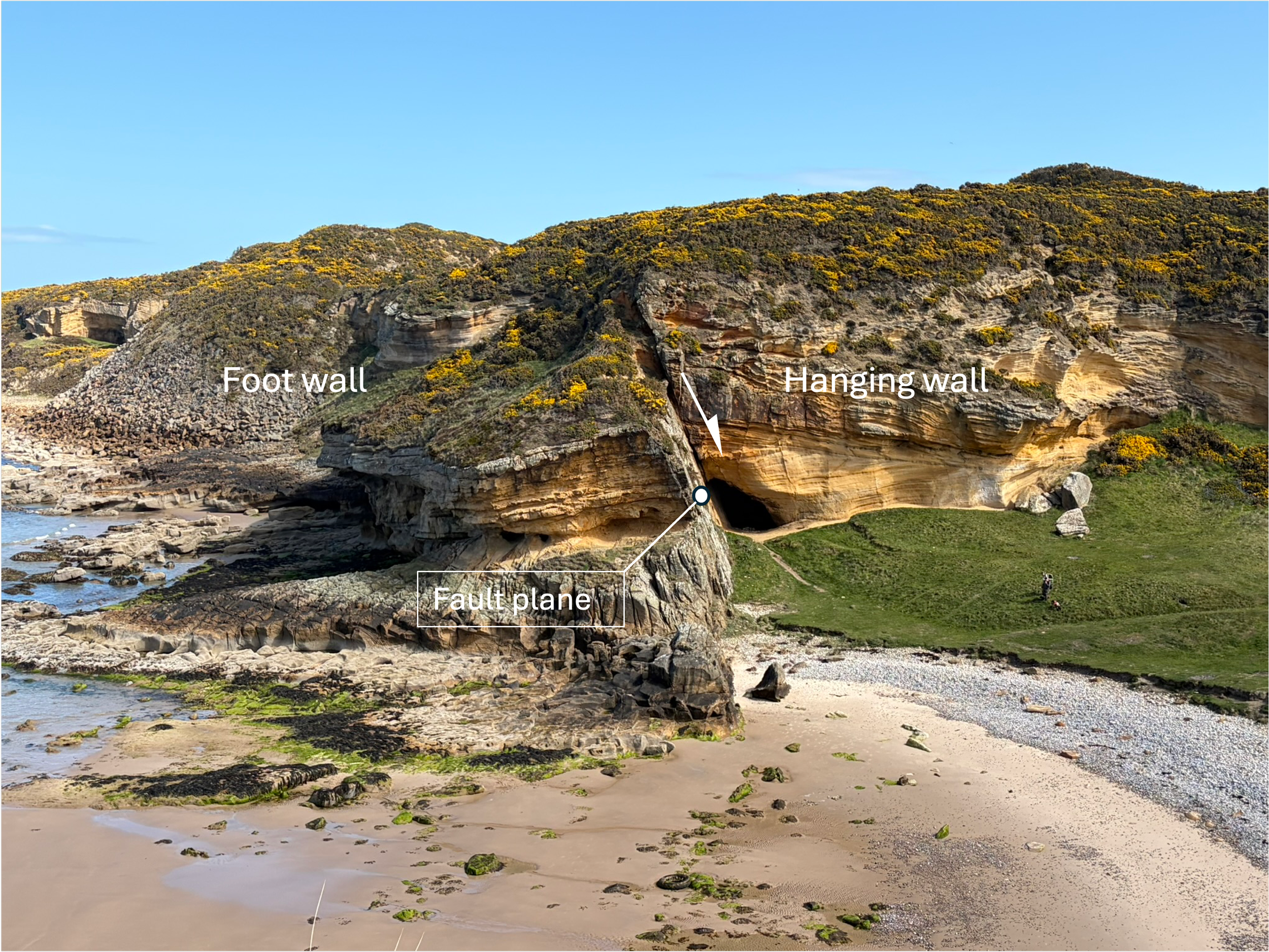
View of Clashach Fault from hilltop
Probably the best exposed fault along this stretch of coastline where the Permian age Hopeman Sandstone appears as cliffs and foreshore exposures. This photo was taken from the hillside on the other side of the bay in which this fault is exposed - I was part of a group of about 50 folks who were checking out the geology of the Hopeman Sandstone, including faults/fractures, fluidisation structures and reptile trackways - as part of the Ken Glennie commemoration event (8th to 10th May 2026).
Is this a normal fault ?
Yes as the hanging wall has dropped down past the footwall. It trends in an approx. E-W direction. From the photo and in the field it is difficult to work out the throw of this fault but some structural work using borehole data, thicknesses and regional considerations suggests that it is no more than 50 metres.
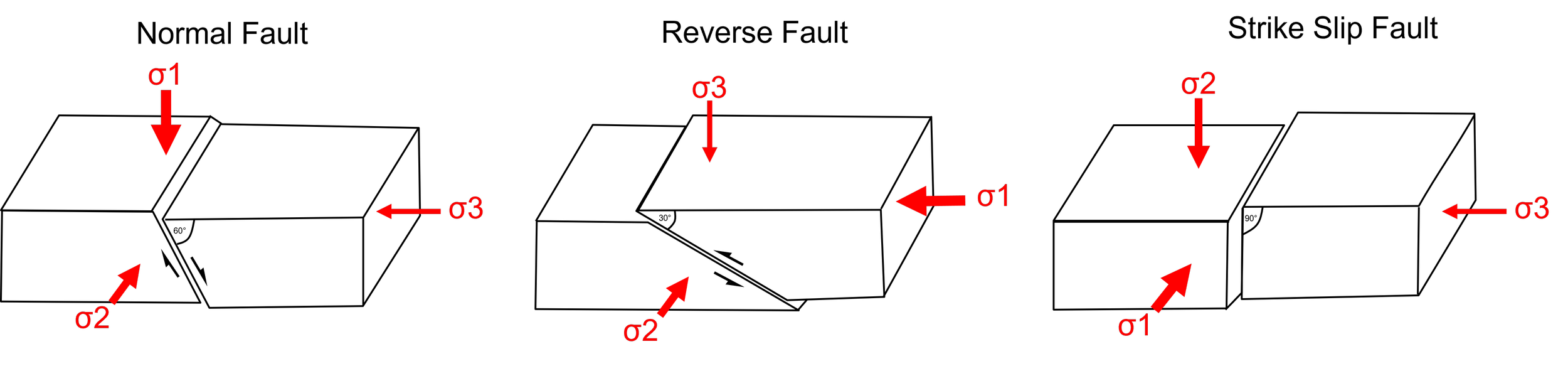
Different types of faults
Slickenlines
When we got down to the fault plane (on the photo), we could see an obvious set of dipping slickenlines (top left to bottom right) on the fault plane which tell us that the movement was not entirely vertical - in fact there was some sideways movement so on examination of the fault plane (close up) we could call this an oblique slip fault. Slickenlines often record the last movement on the fault and indeed the clear set appears as a series of rib-like structures that run from top right to bottom left when facing the fault plane. This normal-dextral movement likely occurred when the fault was reactivated during the Cenozoic. We struggled to see them - but Tamas et al [1] recorded an earlier set that runs top left to bottom right suggestive of a left lateral (or sinistral movement). These (the yellow set below) are likely to represent fault movement during the Late Jurassic to Early Cretaceous. These are apparently cross-cut by the later (red) set. Anyway, these observations would suggest multiple periods of reactivation of the fault.
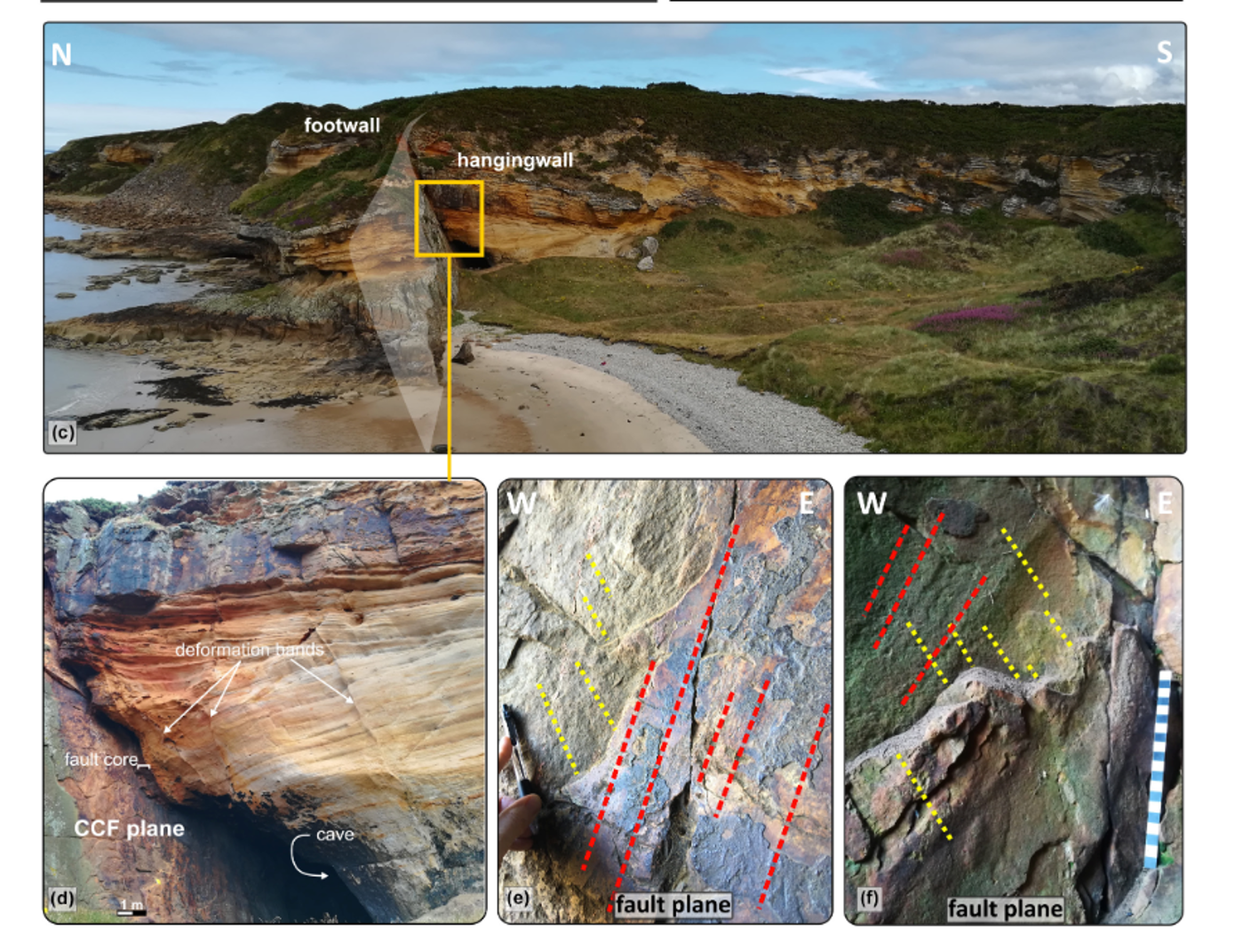
Details of the structure of Clashach Cove Fault including deformation bands in the hanging wall (c), and 2 sets of slickenlines (e,f) where the red ones (normal, dextral) are the later (Cenozoic) ones and the fainter yellow ones have resulted from normal/sinistral movement in the Upper Jurassic/Early Cretaceous. From Tamas et al (2020).
The fault plane is polished and has iron mineralisation (e,f above). There is also a roughly 30 cm wide fault core consisting of iron stained, orange-brown gouge (d above). Away from the core, into the hanging wall, a (few metre wide) damage zone can be seen. This contains a series of thin white coloured deformation bands that decrease in density away from the fault.
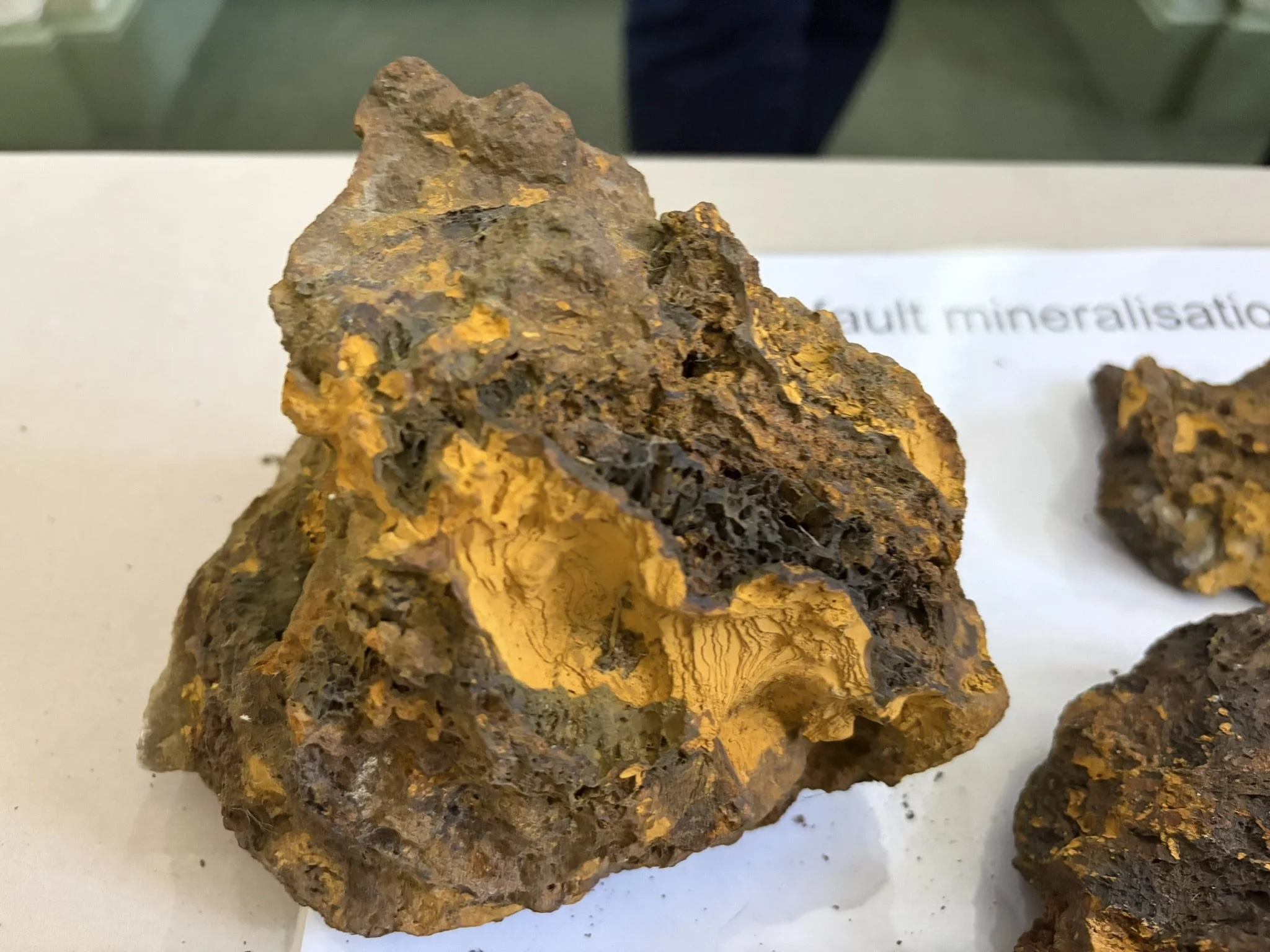
Fault rock from a fault at the back of Clashach Quarry which is largely quarried out now.
Nearby faults
There are a few zones of deformation bands on the foreshore before reaching the hilltop view of the Clashach Cove Fault. These look like shark fins, jutting above the wavecut platform due to their relative resistance to erosion.
Another fault in Clashach quarry itself (landward of Clashach cove) is largely quarried out - it had a similar E-W orientation to Clashach Cove Fault and was home some spectacular iron mineral textures. This piece held in Elgin museum almost looks like the inside of a crunchie chocolate bar made by Cadbury’s here in the UK. This fault is likely to have had a similar structural history to the Clashach Cove Fault.
[1] Link to Tamas et al. 2020 paper https://onlinelibrary.wiley.com/doi/full/10.1111/bre.12661