

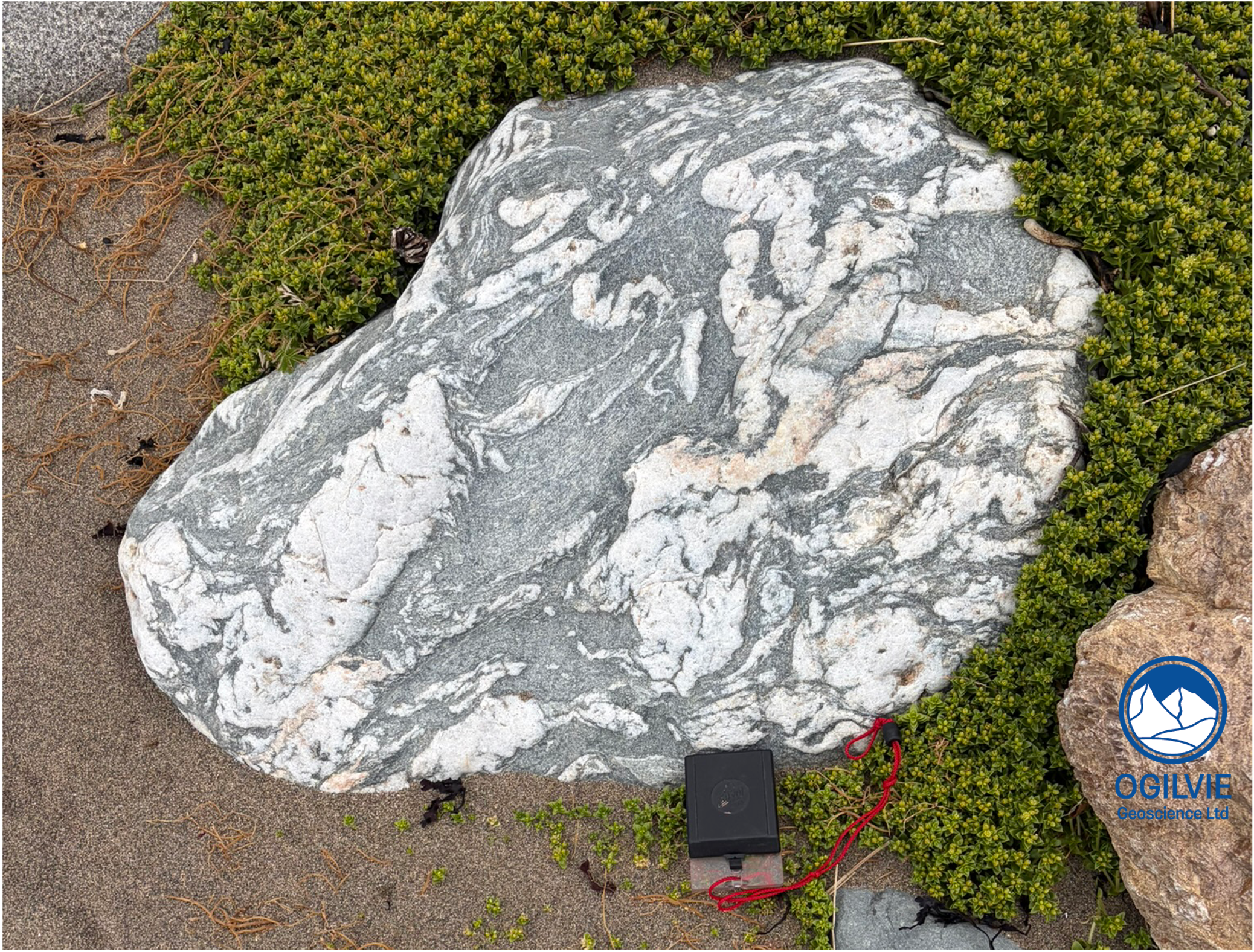
Classic looking gneiss with contorted foliation from Craigeven Bay, Aberdeenshire
What is a gneiss in geology ?
Gneiss is a metamorphic rock that has formed at high temperatures and pressures - it’s what is known as high grade metamorphism. It looks very different to lower grade rocks such as schist and slate in that it doesn’t have a layered (or more correctly a foliated) appearance.
Instead, as we can see opposite, there are white and dark minerals that have segregated into light and dark bands. These bands appear folded, particularly the white ones, although the darker bands are also folded, just more difficult to see next to the folded white bands. White coloured minerals are mainly quartz, feldspars and muscovite. The dark minerals are biotites and ferromagnesium minerals such as hornblende.
Another type of gneiss (a bit more unusual) has a spotted appearance - in fact the white coloured porphyroblasts of feldspar are a bit stretched across the sample, following the foliation. As they look like eyes and the German name for eyes is augen, these have been called Augen Gneisses.
These gneisses can only be found as a few isolated boulders in this area - they don’t form any rock outcrops here. Therefore, they have most likely been carried here and dumped by the action of ice during the last ice age (around 15 000 years ago). We call these transported blocks (by ice) - erratics.
In fact, exposed metamorphic rocks here immediately north of the Highland Boundary Fault are much lower grade (lower temperatures/pressures) rocks called phyllites. Phyllites look more like a schist than a gneiss in that they have a well defined foliation along which they can split (cleavage).
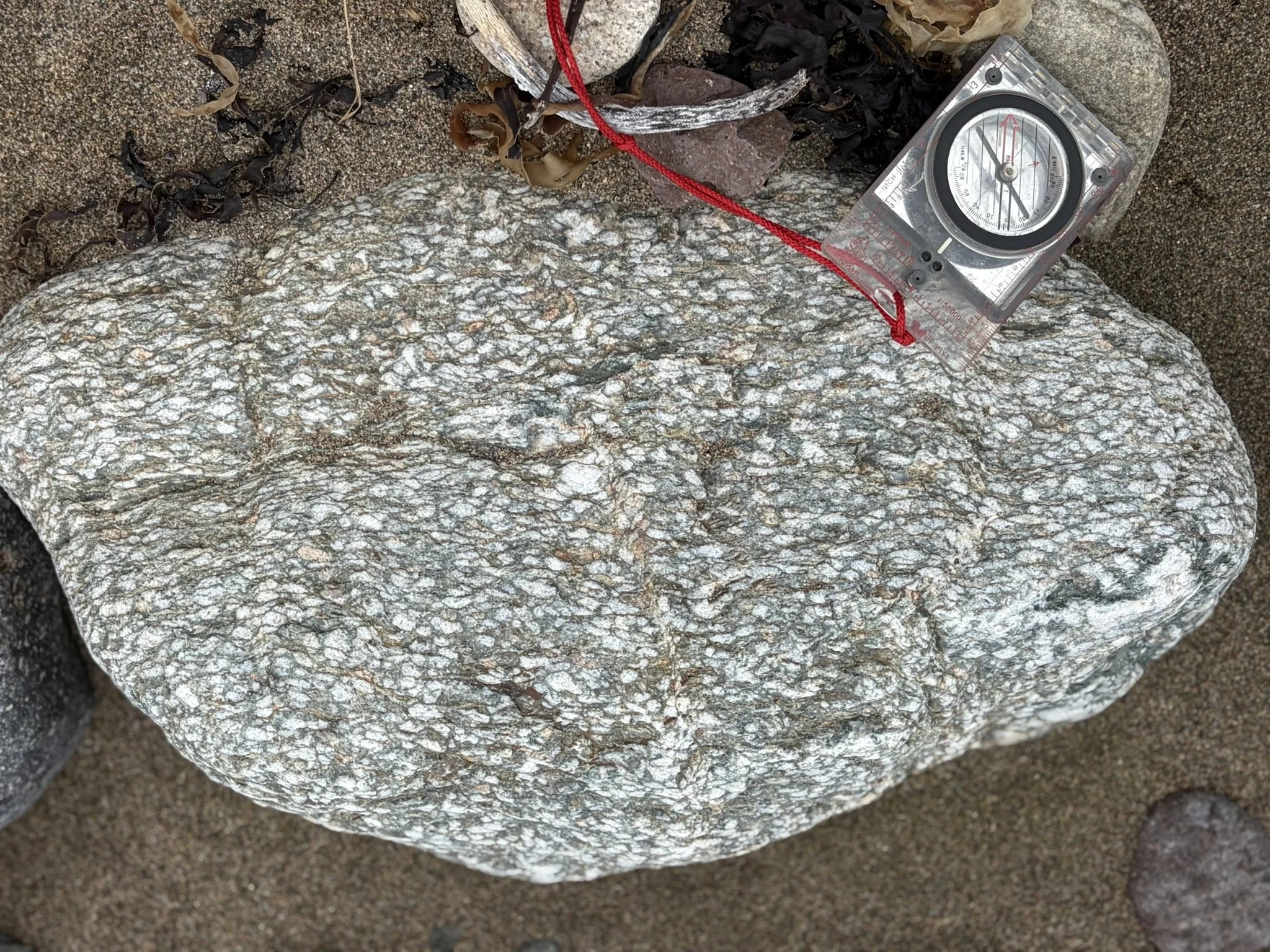
A boulder of Augen Gneiss in Craigeven Bay, Aberdeenshire - a good example of a glacial erratic.
Barrovian zones of metamorphism
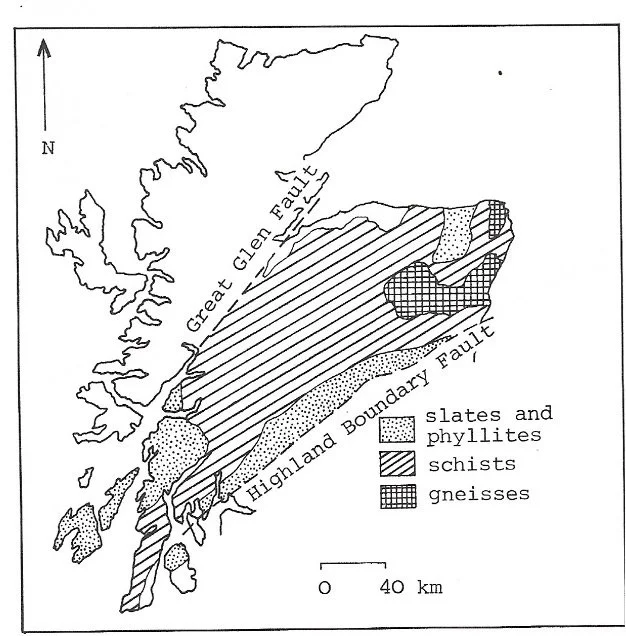
General distribution of metamorphic rocks in the Grampian Highlands
This map shows the distribution of metamorphosed rocks in the Grampian Highlands of Scotland - the area between the Highland Boundary Fault and the Great Glen Fault. George Barrow mapped out the various zones (in the early 20th Century) - generally there is a progression from the south and west to the north and east passing from slates and phyllites (that we see at Craigeven bay) through schists and gneisses. He picked out various groups of minerals that are more sensitive to conditions of metamorphism, allowing a finer zonation to be carried out.
We can use the first occurrence of a new mineral (an index mineral) to mark the start of a new zone - for example, biotite present in phyllite will also be present in schists but the appearance of garnet tells us we are in higher grade metamorphic rocks such as schists. Garnet is not to be found in the phyllites of Craigeven Bay for the reasons given. Instead, biotite is the relevant index mineral.