
Slickenlines
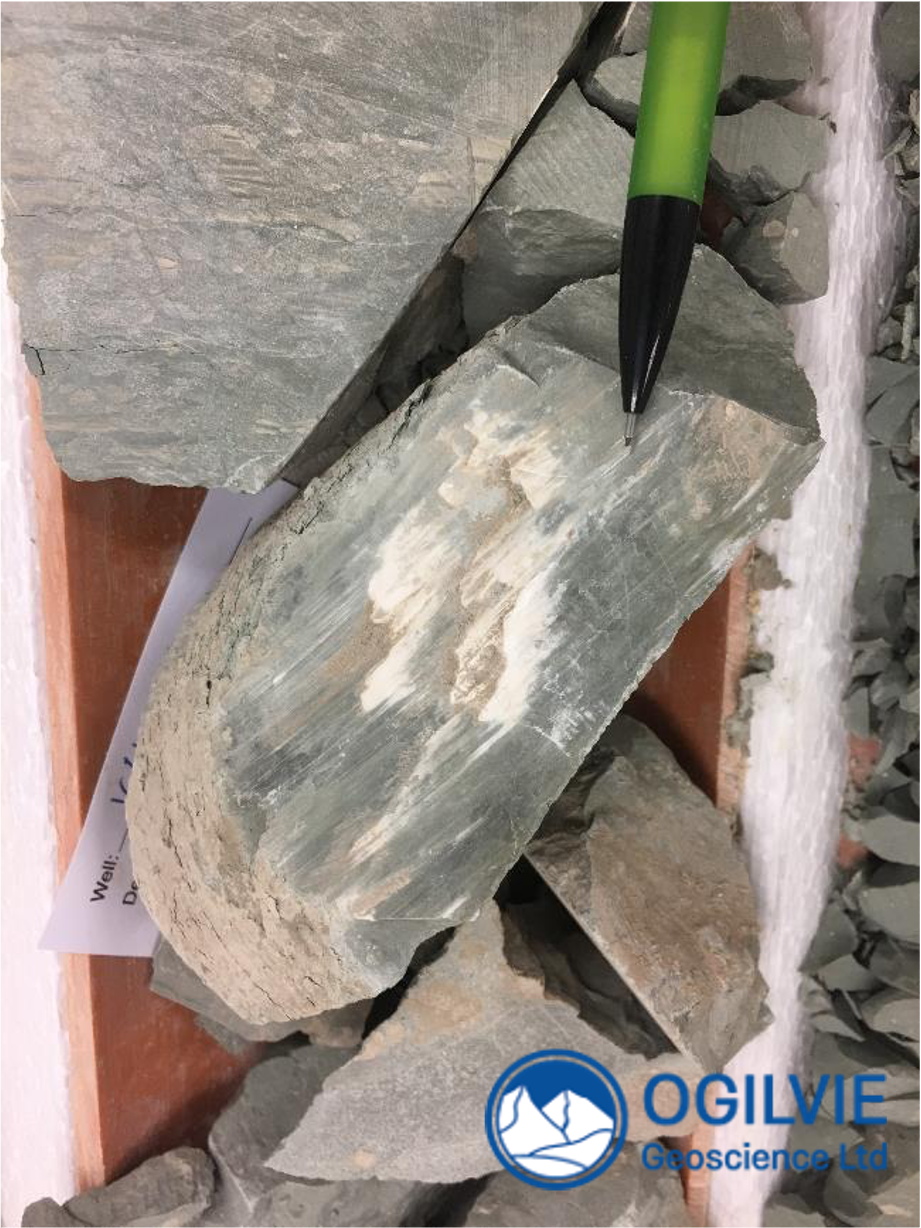
Slickenlines in playa lake siltstones from rock core, N Sea.
What are slickenlines ?
Slickenlines are scratches on fault surfaces resulting from shear motion. Remember that shear fractures are smaller versions of faults that you’ll find in rock core - so slickenlines record the shear motion of fractures. You won’t find slickenlines on joint surfaces as these are opening mode fractures.
Can we tell the direction of travel ?
Its often possible to tell the direction of shear by running your fingers over the slickenlined surface - this would be the smooth direction (top right to bottom left for missing block opposite).
Slickenfibres on the fault plane are mineral fibres that grow during fault movement. These are often quite patchy in appearance - the white cement opposite is likely calcite.
A nice example of slickenlines and slickenfibres on a fault plane in a conglomerate is shown below. The conglomerate is from the Devonian period and is found as an outlier (amongst older rocks) near Tomintoul in the Scottish Cairngorm mountains. First time I’ve come across slickenlines on a fault in conglomerate.
It’s possible that these are scratches created by glaciers, called striations. In this case the cements would have to have been in place beforehand in the rock and it does look like some of these cements have been smeared on the exposed surface.
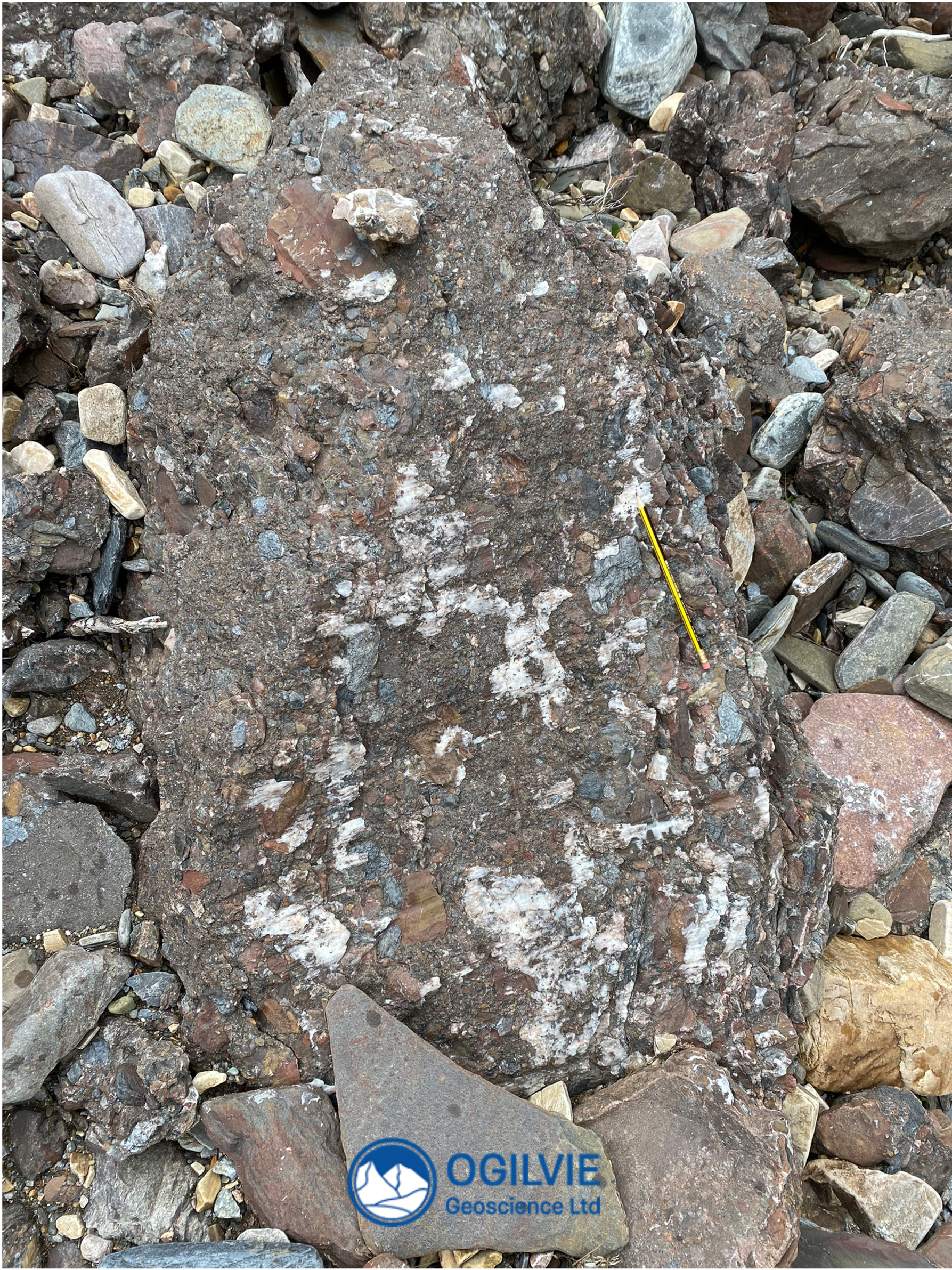
Slickenlined fault surface in conglomerate in Ailnack gorge, Cairngorms, Scotland.
Why are they important ?
Its very likely you’ll come across rubble zones when looking at rock core which have been drilled as part of characterising the reservoir rocks in an oil field or perhaps a geothermal field. Its well worth checking the pieces of rubble (as well as the intact core of course !) for evidence of slickenlines. The reason for this is that you’ll know you’re looking at natural (not induced) fractures.
Below is rubble from North Sea appraisal well that was drilled through a seismically resolvable fault in sandstones. The piece of sandstone that the pencil is pointing at has a particularly well developed polished surface and slickenlines - indicating natural shear fractures and consistent with the seismic evidence of a fault being present in this area.
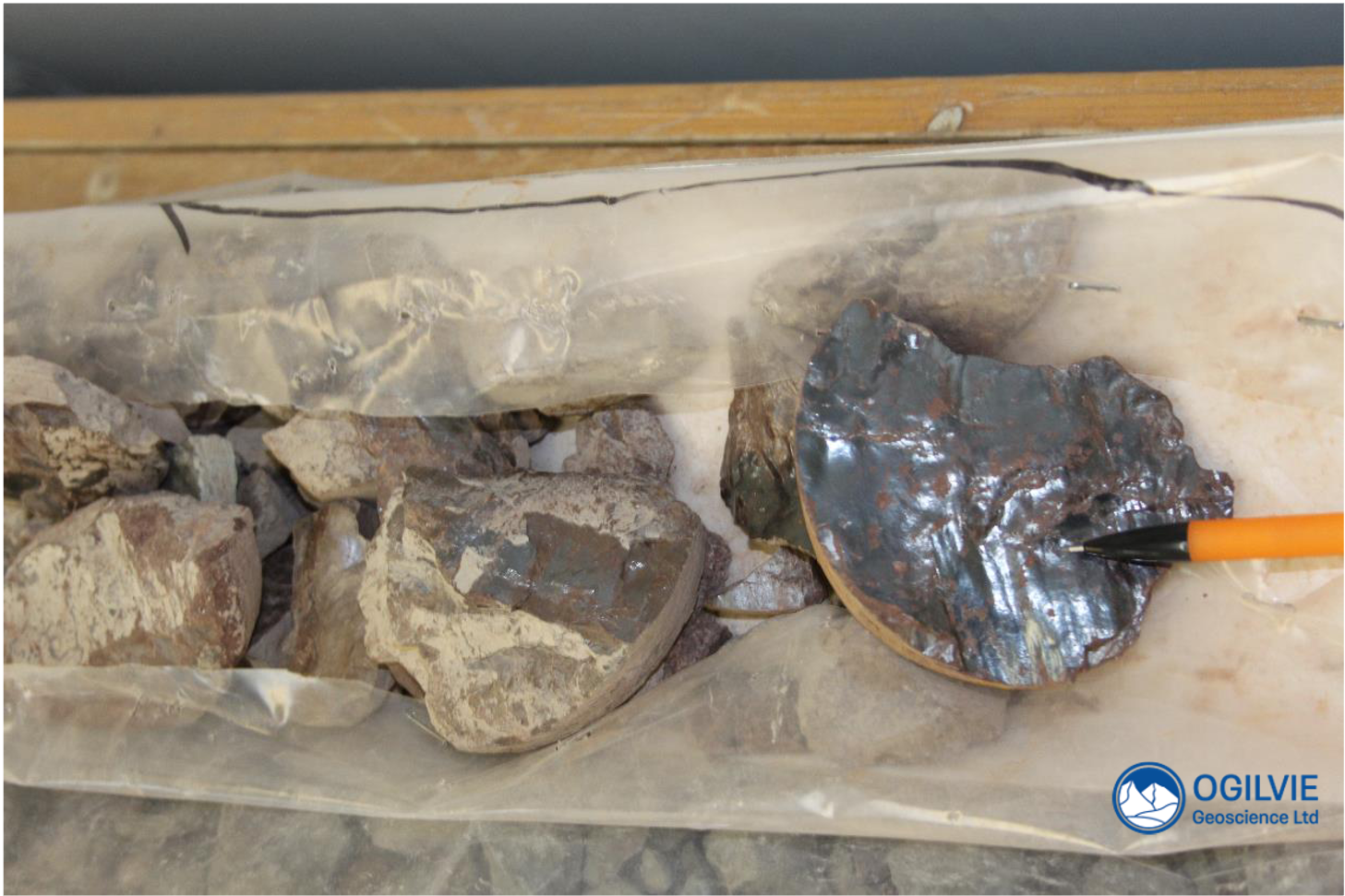
Slickenlines and polished surface in Jurassic faulted sandstones from the North Sea.
Slickenlines can also help us understand the structural evolution of our study area. Ideally, they should be studied directly on fault planes in rock outcrops - it’s usually more straightforward to take measurements in outcrop than on core as the core has to be oriented.
The fault below is found within Permian age dune sandstones. Given the easy accessibility of the fault plane in Clashach Cove, it is worth checking it out for slickenlines and other structures. Most of the faults in this area are normal faults as is this one and we’d expect any slickenlines to run up and down the fault plane. But these rib-like slickenlines run (or plunge) diagonally from top right to bottom left indicating that the fault has had some oblique movement. In other words, there has been some movement along strike as well as in the direction of dip. This is consistent with regional work on seismic data in the Moray Firth that the basin has also experienced strike-slip tectonics [1].
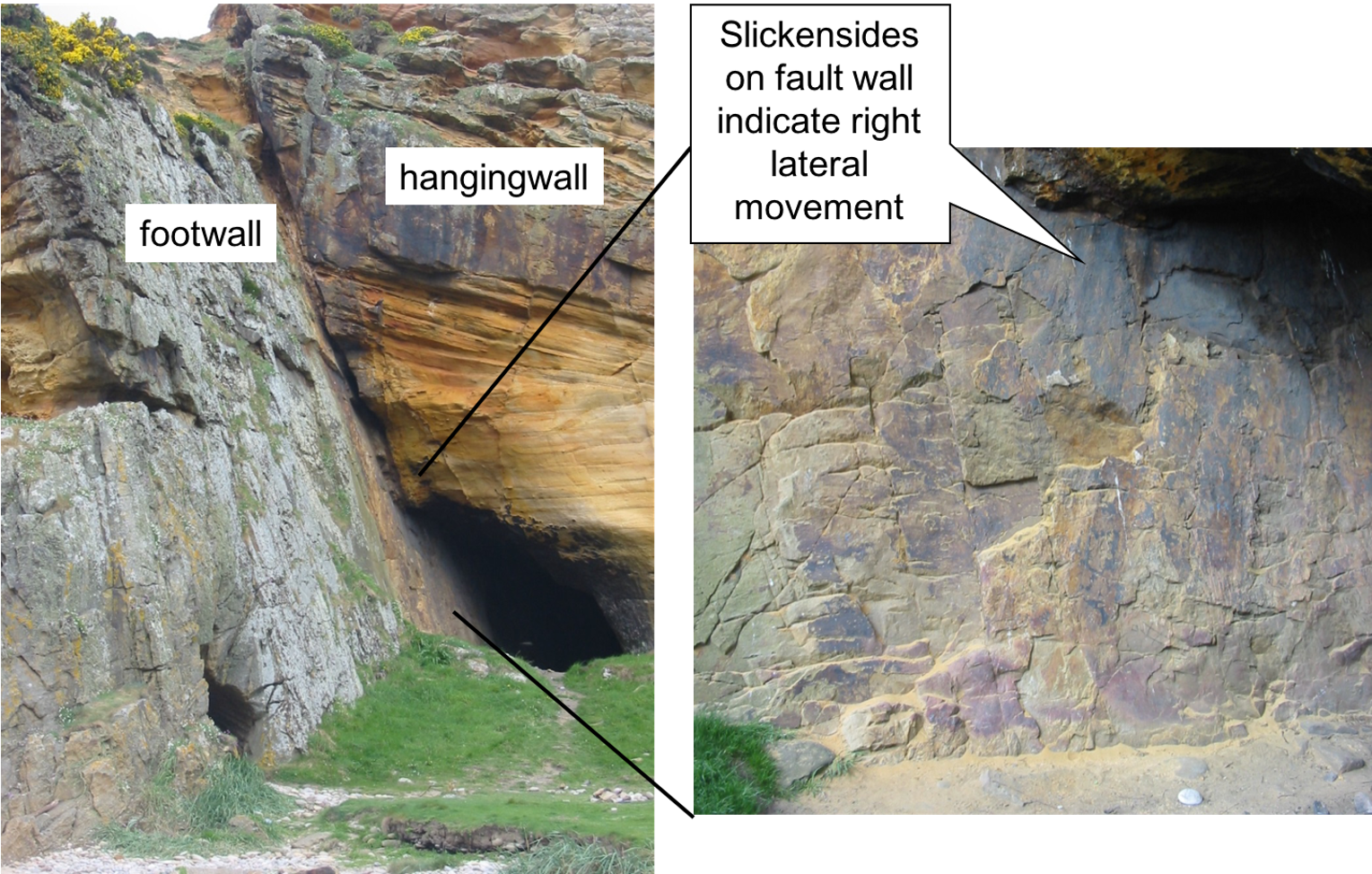
Footwall and hanging wall of the Clashach Fault in the Hopeman Sandstone, Moray, Scotland. On the right, looking onto the fault plane with it’s rib like slickenlines running diagonally from top right to bottom left.
[1]. Roberts, A.M., Badley, M.E., Price, J.D. and Huck, I.W. 1990. The Structural History of a transtensional basin: Inner Moray Firth, NE Scotland. J. Geol. Soc. London, 147,7- 103.