
Shear Fractures on Folds, St Andrews, Scotland
What are shear fractures ?
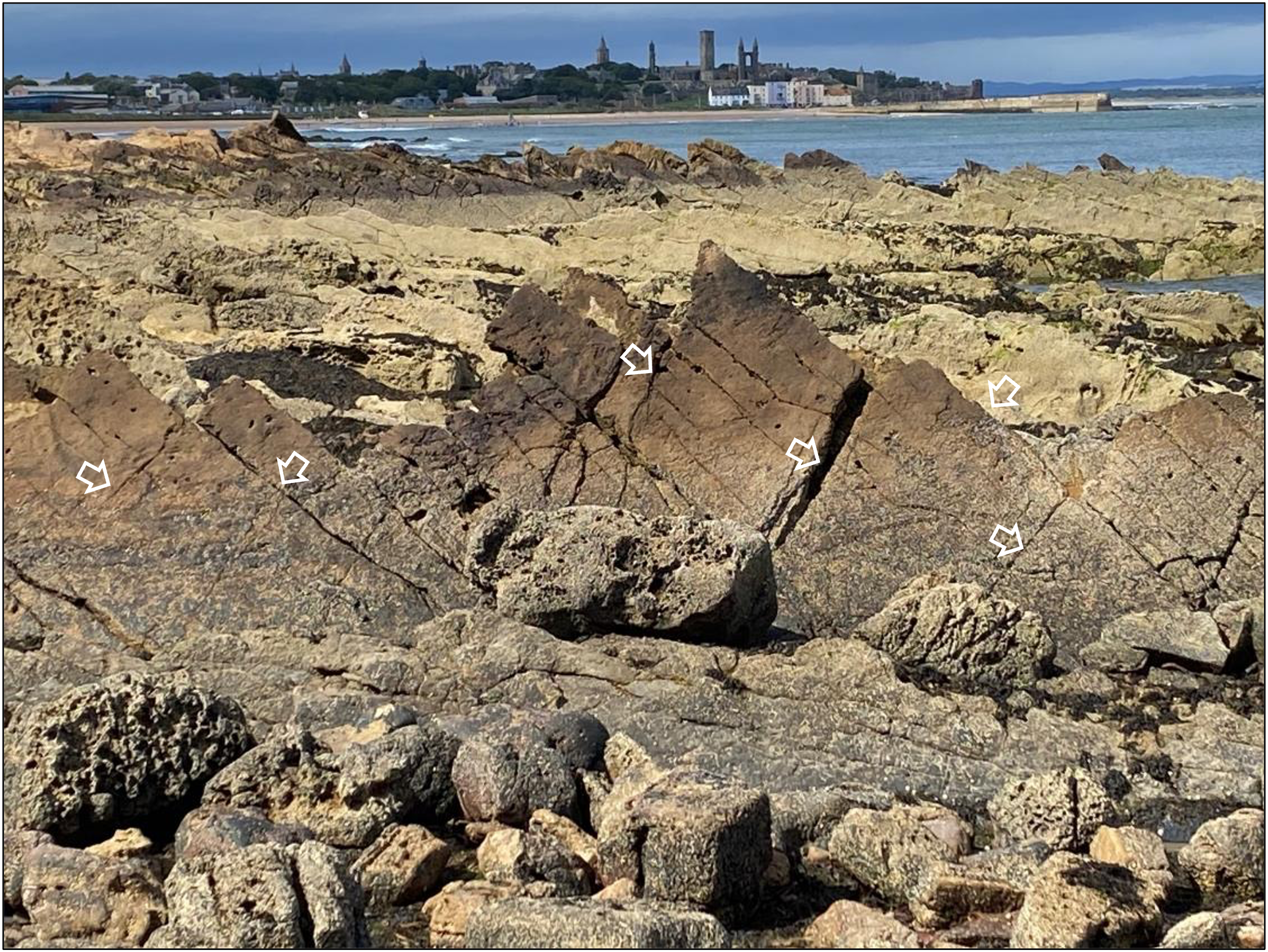
Shear fractures found on sandstone beds of a fold limb with St Andews in the distance.
Shear fractures are small faults that often dip at about 60 degrees and involve some displacement of the rock in which they are found. They can be created by the process of folding and their distribution would therefore be related to local stresses arising during folding.
Opposite the white arrows point to some shear fractures in steep sandstone beds of a fold to the East of the town of St Andrews in Fife. The folds have been created during the Variscan Orogeny by faulting and then the shear fractures created during folding.
Predictive model by Stearns
Based upon extensive outcrop work in the 1960s and 70s on the Teton anticline, Wyoming (US), Stearns produced a nice predictive model for the distribution of fractures on folds [1]. Type 1 fractures contain shear fractures and extension fractures that result from compression and type 2 contain shear and extension fractures that result from extension. Type 3 form in the cross section of the fold.
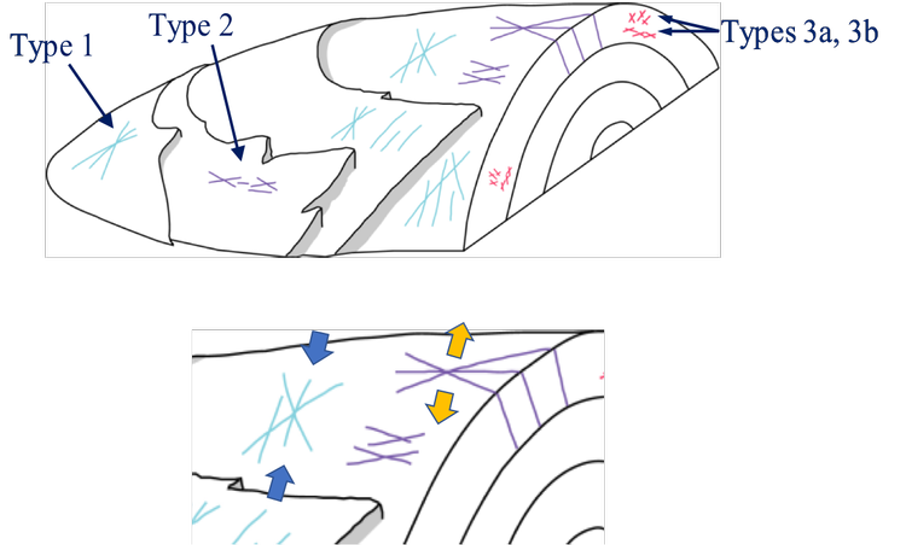
Fracture types related to folding after work by Stearns in the late 1960s and 70s.
Example from Brazil
The fold below is a hand specimen (about 8 cm across) from the Sao Francisco Basin, onshore Brazil [2]. Alternating carbonate - shale layers have been folded into a tight (chevron) fold. Note how the shales are thicker in the hinge zone than the more competent carbonate layers. This is because a void is created as a result of the more competent units more or less retaining their thickness. The void then gets filled by the more incompetent shales [3].
I’m particularly interested in the fracture network on the limbs of this anticline. On middle image, we are looking at the limb on the right hand side of the fold hand specimen. We can interpret 2 fracture sets; the red set runs from top right to bottom left and the pink set from top left to bottom right. There is no dominant set. These look like they belong to Stearn’s type 2 resulting from local extension during folding. This hand specimen fold can be used as an analogue for fold-related fracturing in tight folds of similar geology (mechanical stratigraphy).
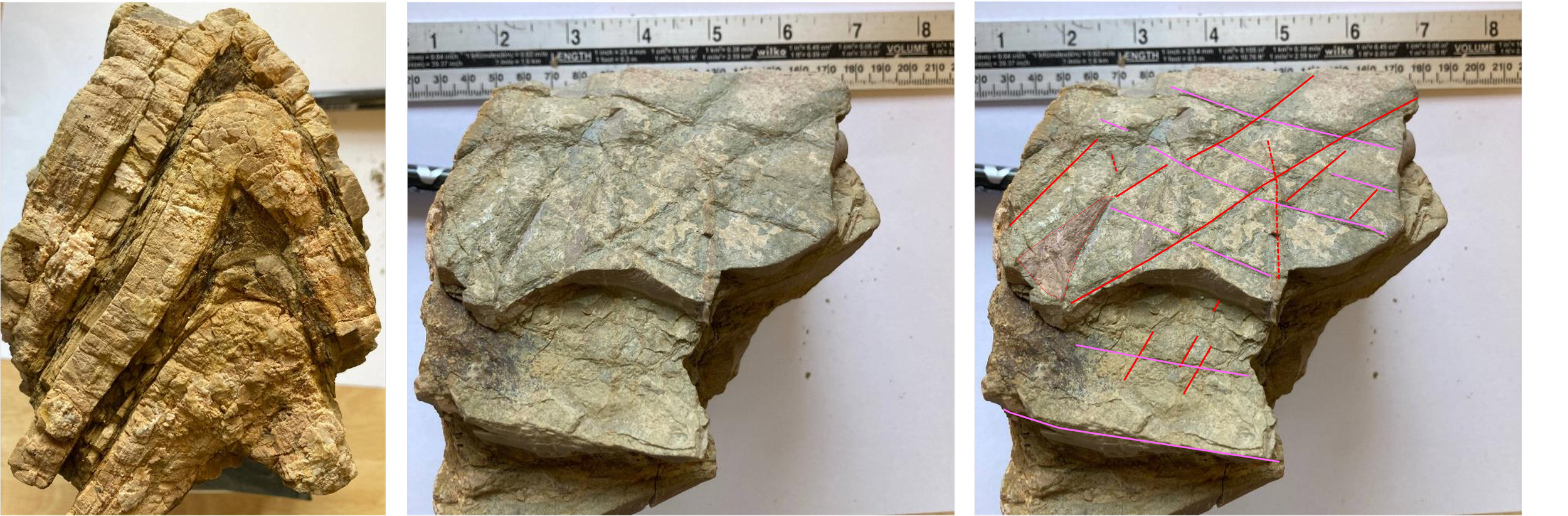
Late Precambrian Bambui Group carbonates of the Sao Francisco Basin, onshore Brazil. Folded during the Cambrian. Sample and photo from Andy Racey.
[1] Stearns D.W. & Friedman, M. 1972. Reservoirs in fractured rock. In: Stratigraphic oil & gas fields – classification, exploration methods and case histories. R.E. Kring (ed). AAPG Memoir, 16, 82-106.
[2] Martins-Neto, M.A., Pedrosa-Soares, A.C., Lima, S.A.A. 2001. Tectono-sedimentary evolution of sedimentary basins from Late Paleoproterozoic to Late Neoproterozoic in the Sao Francisco craton and Aracuai fold belt, eastern Brazil. Sedimentary Geology 141 - 142, 343 - 370.
[3] Ramsay, J. G., 1974, Development of chevron folds: Geological Society of America Bulletin, v. 85, p. 1741-1754.