
Nodules Galore
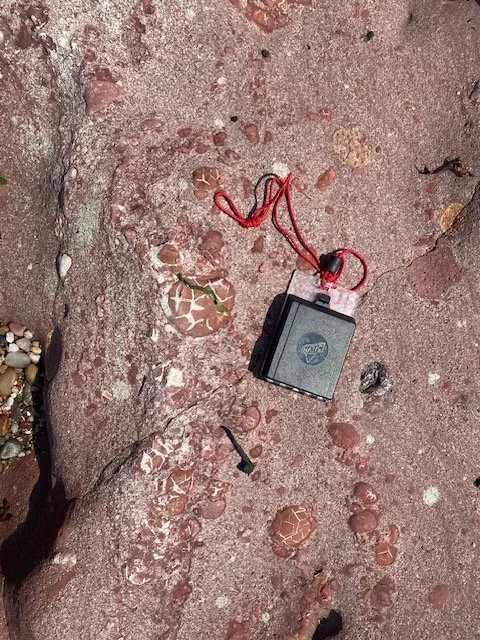
Septarian nodules in Lower Devonian Sandstones along Arbroath coast, E Scotland
It is common to find rounded bodies of all sizes in rock bodies. Not pebbles, these have grown in the rock due to chemical processes. There are 2 main types - concretions and nodules. Concretions tend to have the same mineral composition as the rock in which they occur. We can call this the host rock. Nodules tend to have a different composition to the host rock.
Sometimes nodules have different compartments with different minerals and these are called septarian nodules - after septa which is latin for separation or partition.
The nodules below are found in the Hopeman Sandstone (of Permian age outcropping along the Moray coast) are often star-like and may resemble the petals of roses. As they commonly form in desert environments, they are called desert roses. These form by evaporation in small pools of salty water in sandy, arid environments.
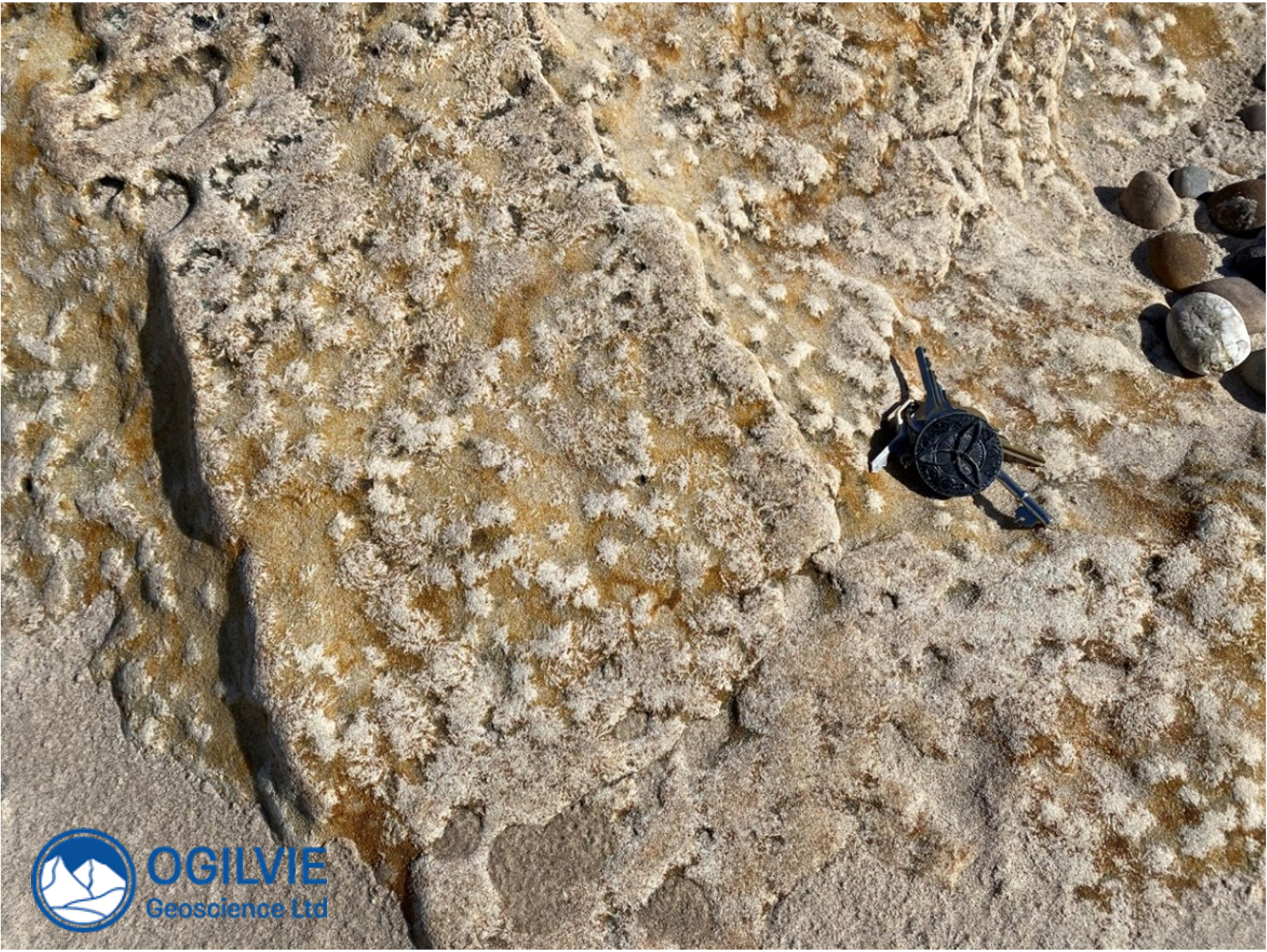
Star-like nodules of barite in the Hopeman Sandstone, Moray, UK
The nodule in cored mudstones below (left) has some interesting features. No bedding parallel shear is observed but chemical zonation indicates a rapidly evolving flow. The associated curved fractures look almost like they are induced but they are natural given the evidence of a small displacement on the nodule rim.
Carbonate nodules are common in North Sea mudstone/shales which form the overburden rocks for many reservoirs. They can be tested to see if they fizz with dilute hydrochloric acid. As they are generally localised, they are not of significance for hydrocarbon exploration/recovery. But geological observations around the nodules can provide valuable insights into the geological history. I’ve also observed core jam-offs at the level of zones of concretions. So, it’s very useful to know something about their genesis and likelihood of occurrence. The dolomite concretions in the shale core (below right) have been sheared along the bedding planes i.e., bedding parallel shear. Note the haloes of cement around each concretion showing that there has been some recrystallisation around the original concretion. There is a lot of detail in this large nodule ! - recrystallisation (note the mosaic of crystals) at the top right of the concretion before it tails off into 2 arms - which appear to follow the concretion-related fractures.
The pencil points to a large healed fracture. Thin-sections would be useful here to check the type of mineral fill and the chronology of events. Note also the compaction of shale layers at the base of the concretion indicating that the substrate was relatively soft at the time.
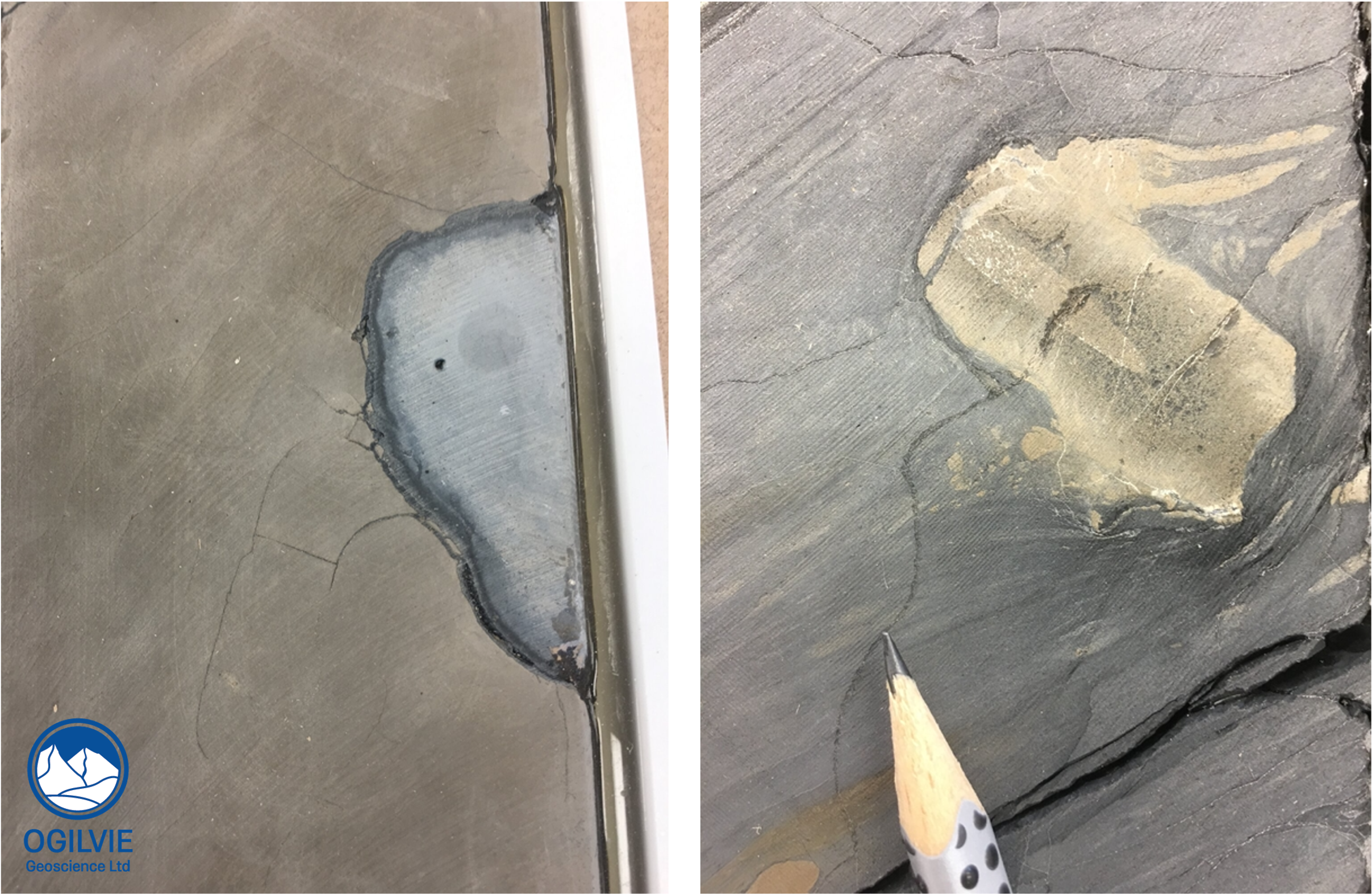
Examples of nodules in North Sea cored mudstones/shales: Left carbonate nodule with related fractures - in a Central North Sea (Tertiary age) Mudstone (b) Bedding parallel dolomite concretion in Cretaceous shale in the N Sea-a lot of detail which provides insights into the geological history.
The diagram below shows how the rate of deposition impacts the shape of nodules or concretions. If the deposition is slow, they may be more rounded and larger than if deposition is rapid where they can be small and stunted. This rounded nodule (above, left) indicates slow deposition, whereas a smaller, more irregular (stunted) concretions would indicate more rapid deposition.
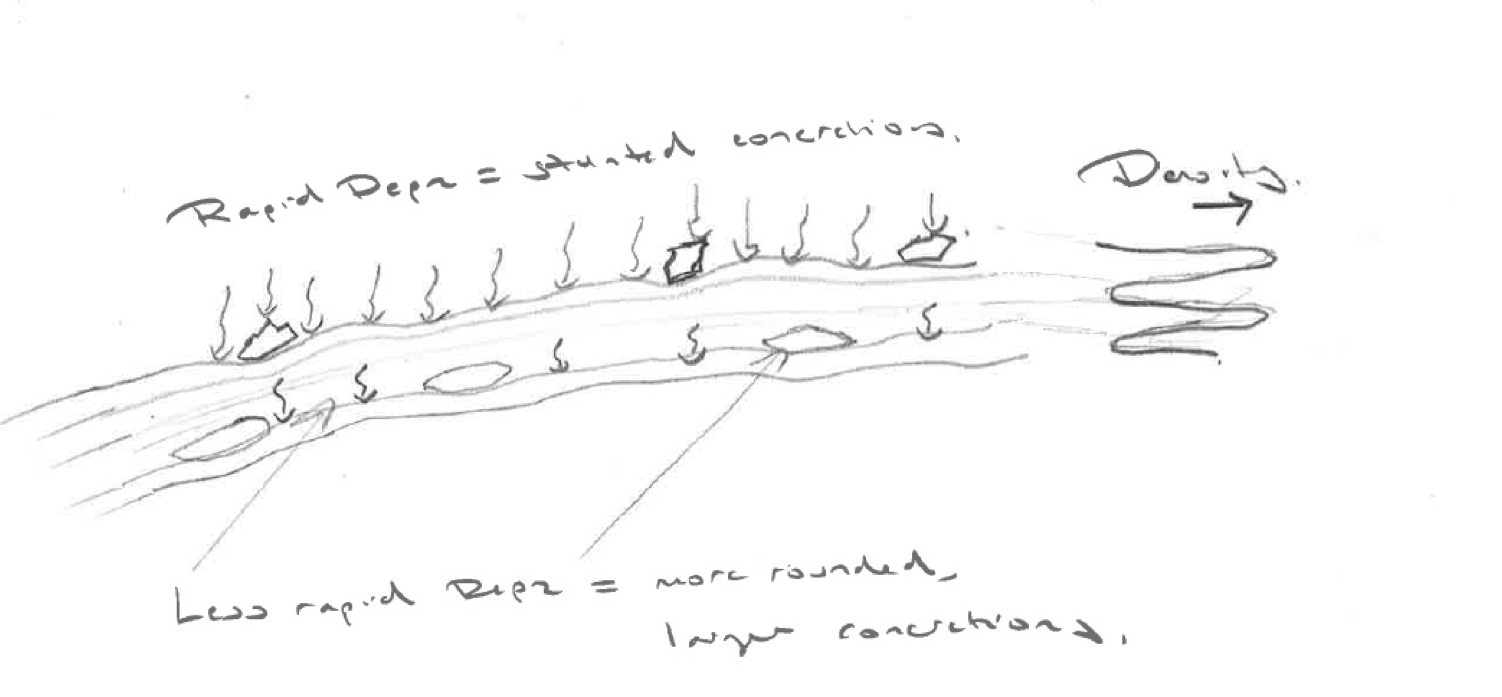
Concretion shape and rate of deposition. Density log signature on right hand side.