
A trip to Aberlemno Quarry in Midland Valley
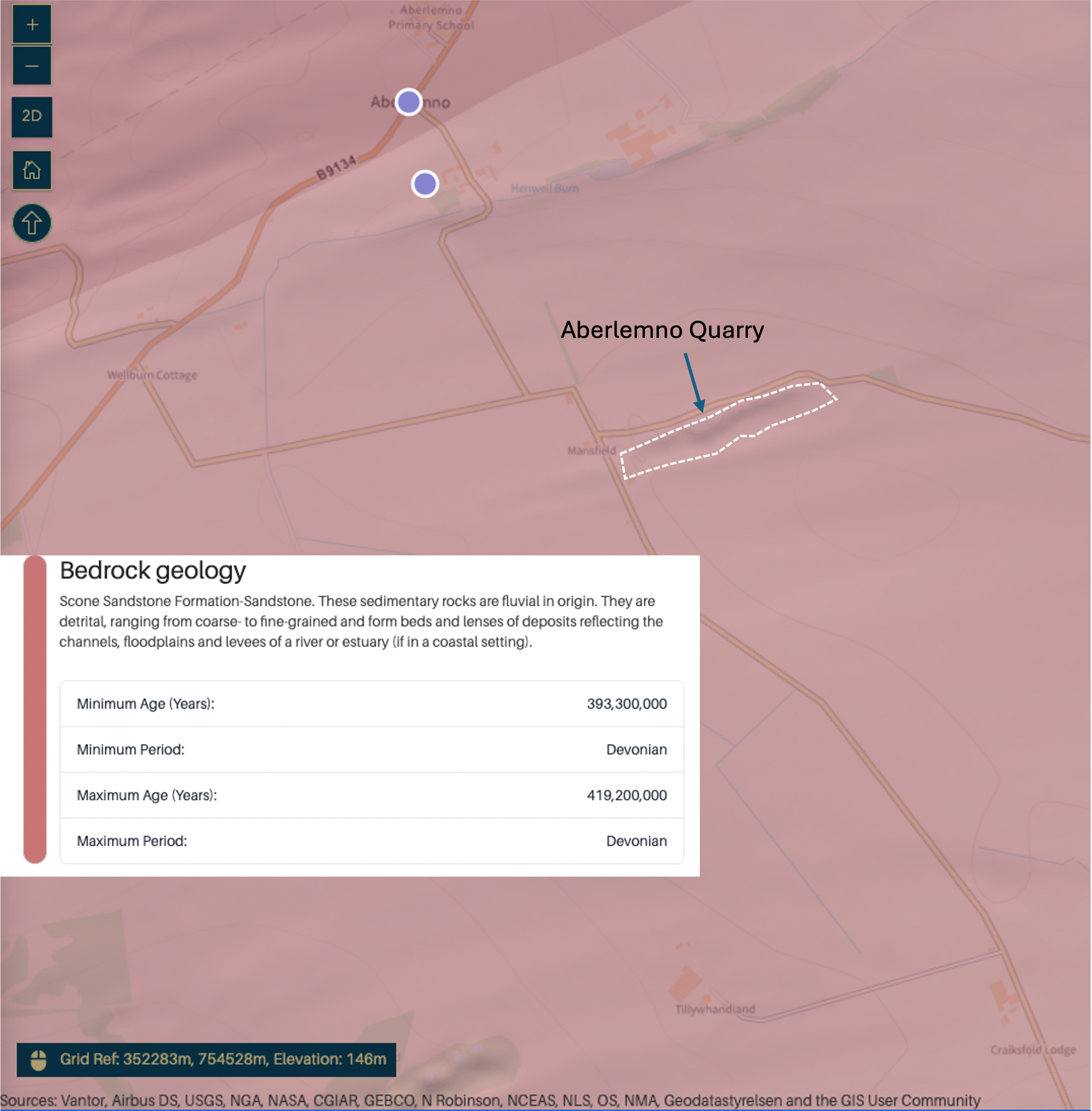
Location of Aberlemno Quarry just to the S of Aberlemno - image from BGS geology viewer
Last year (Oct 2025) I was looking for some rock outcrops to stop at in the Dundee area on my way back to the NE of Scotland from Perth - I checked out the geosites interactive map from Scottish Geology Trust and came across Tillywhandland Quarry where significant fossil fish, plant remains and arthropods have been found in the Lower Devonian sediments.
https://www.ogilviegeoscience.com/blog/tillywhandland-quarry-a-fossil-fish-locality-central-scotland
It is located just to the west of the town of Forfar near the village of Aberlemno and is part of the Turin Hill SSSI (site of special scientific interest). Another less well known quarry (for fish remains at least) is found just a few minutes drive from Tillywhandland - this is Aberlemno. In late Feb 2026, I was fortunate to be shown around this quarry by Bob Davidson MBE and Danny Long.
Please get permission from farmer/landowner before collecting any material and visiting these quarries.
The waste material includes finer grained mudstones and shales that couldn’t be used in construction (buidlings, roofs, dykes around fields) as would easily disintegrate [2]. This ended up mixed with other material on spoil heaps. The spoil heaps are a valuable source of fossils but have also been used by landowners to fill potholes.
In Tillywhandland, the sandstone that was quarried lies around 10 metres below the surface and is overlain by around a 1 metre thick laminate. The laminates were of no value to the quarry company but is of great value today as is home to numerous fossil finds. The laminate contains a stacked sequence of siltstone, organic matter, carbonates and green claystones. These events are around 5 mm thick. Fossil fish finds inlcudes the spiny finned acanthodian Euthacanthus.
A short walk over spoil heaps towards to the second quarry allows us to get up close to this sequence. A single bed of volcanic ash known as a bentonite at the top of the laminate unit is evidence of volcanic activity here in the Lower Devonian - there is evidence of volcanic activity elsewhere in the Midland Valley, e.g., at Stonehaven [2]. There are also some sandstone injection structures in the laminate - injected from the quarried sand unit below.
Geology of Aberlemno Quarry
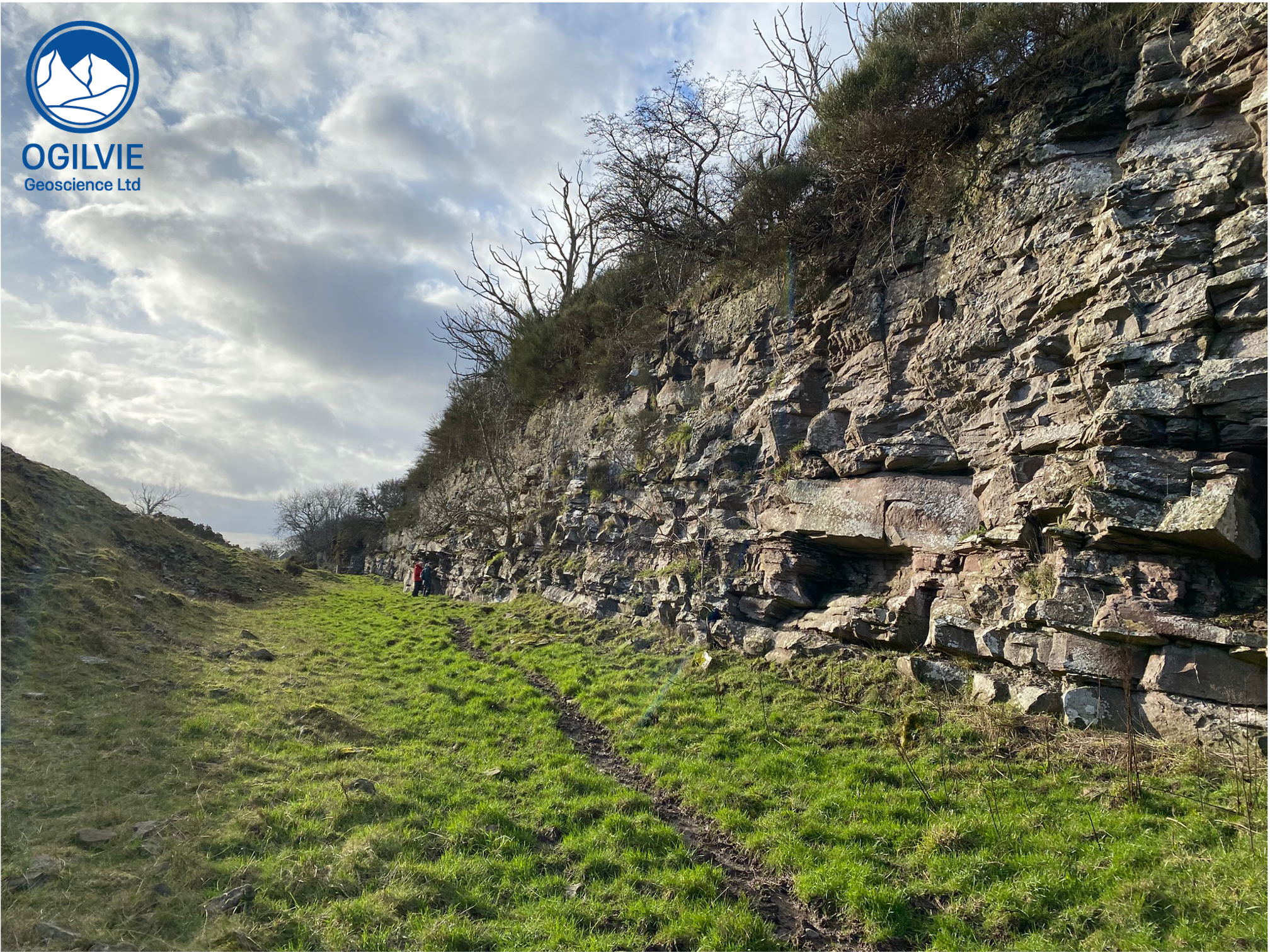
Facing west along the long (mainly) sandstone exposure at Aberlemno quarry.
Closer to Aberlemno, this quarry is quite a different shape to Tillywhandland - elongate in an approx. E-W direction (see map above) with spectacular outcrops of flvuvial sandstones from the Scone Sandstone formation on the north side and spoil heap material on the south side.
The sandstones have many examples of cross bedding - commonly there are quick changes in the direction of cross bedding from sand to sand. This is expected in point bars filling channels in energetic rivers that we see evidence of here. These cross beds can also be seen at Auchmithie (on the coast) in the Scone sandstone. The channel sands are separated by finer grained (muddy) rocks which are likely floodplain or perhaps alluvial plain deposits. The channels contain rip up clasts of these rocks.
Explosives would not have been used during quarrying here - but you cannot miss all the quarrying marks. There are half tube marks which are vertical - these are likely manual drill marks formed by turning a drill at the top followed by prising out the rock with steel rods. This process may have been aided by steam. There are also many (less vertical) marks which look like tools such as chisels have been used.
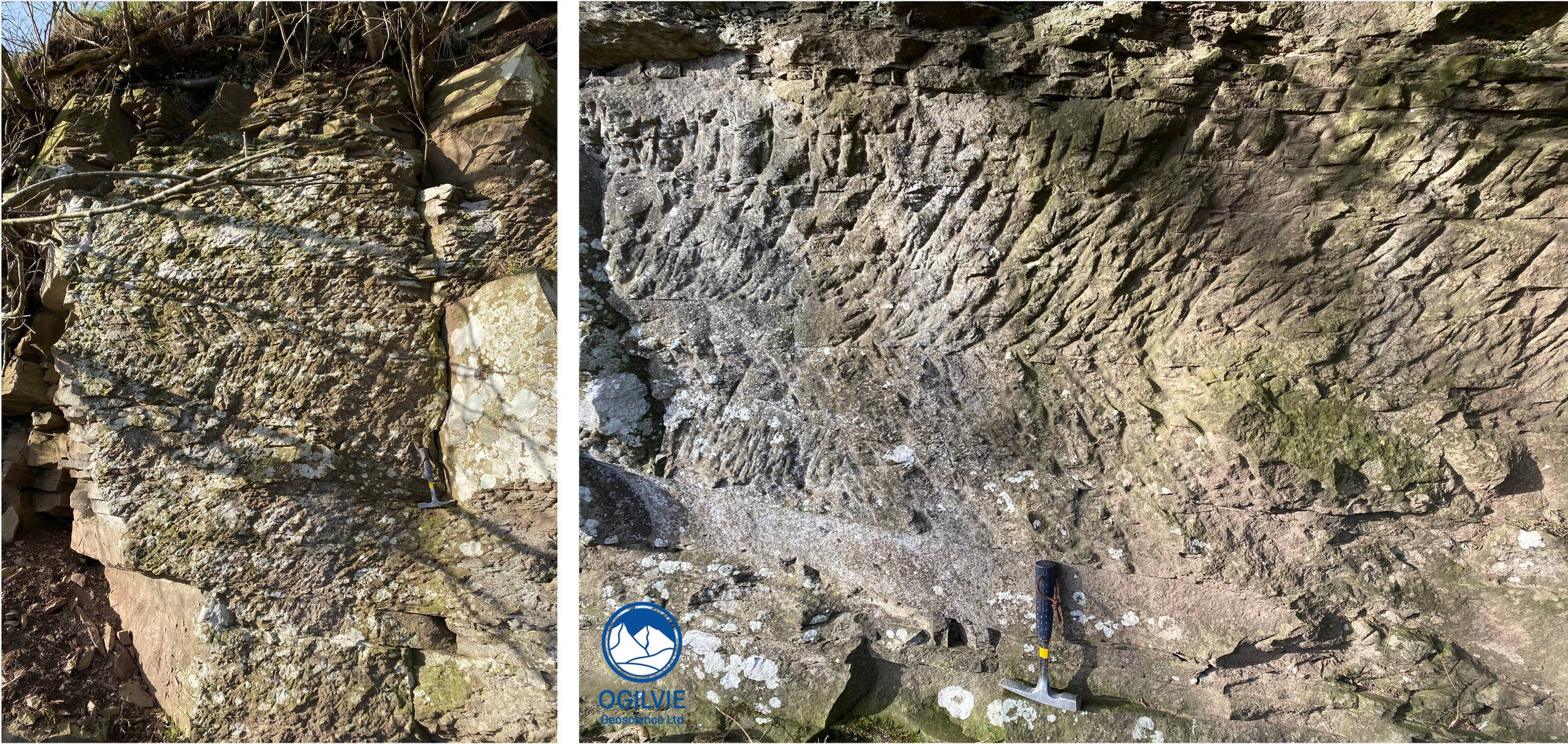
Cross bedding in the Scone Sandstone at Aberlemno Quarry. On right view are mix of cross beds and tool marks (more vertical ones at top).
Apart from ubiquitous jointing, there are some specific structures such as the plumose marking (below left). This records the direction of joint propagation and the marks to the right of it may be fringe marks also related to this structure. A small drape fold in the muddy layers appears to have formed over a small fault block in the sandstones.
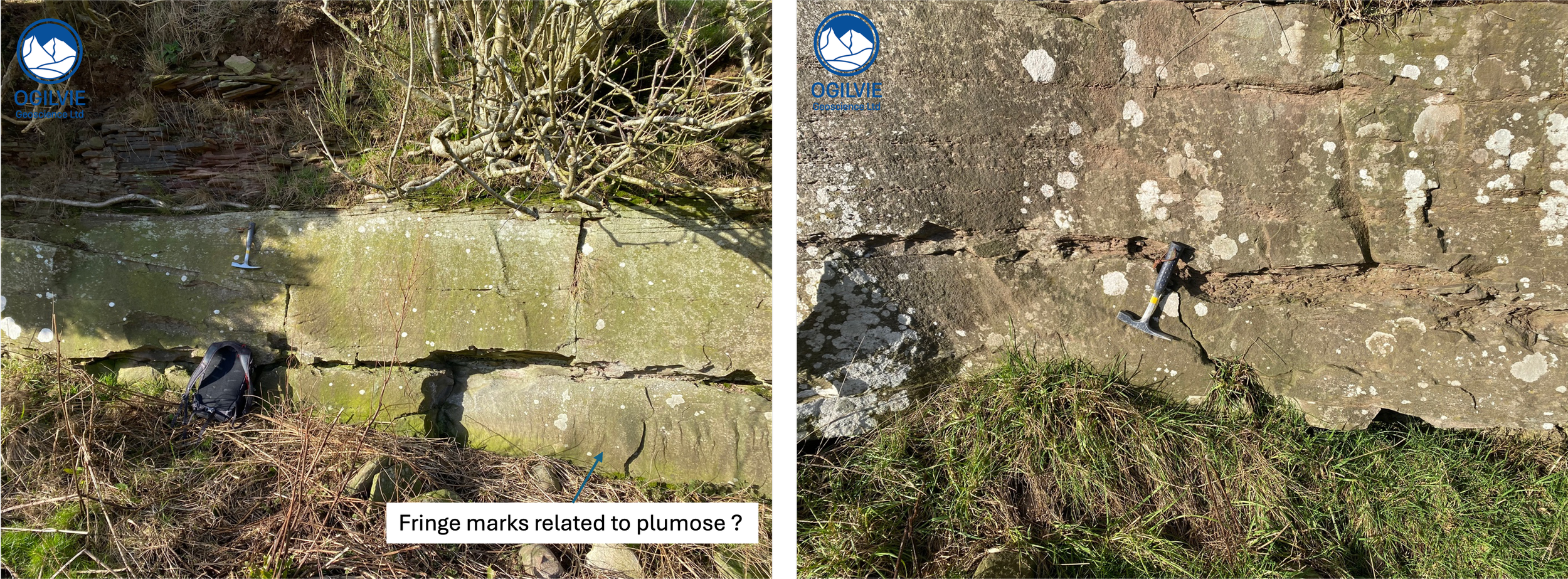
Plumose structure (hammer in middle of it) showing direction of joint propagation and (on right) a small fold in more ductile muddy units in between channels.
We came across some plant material in the spoil heap - interesting that it has a reddish colour unlike the black plant material at Tillywhandland. It has likely been subject to different conditions (more oxidation ?) than those at Tillywhandland.
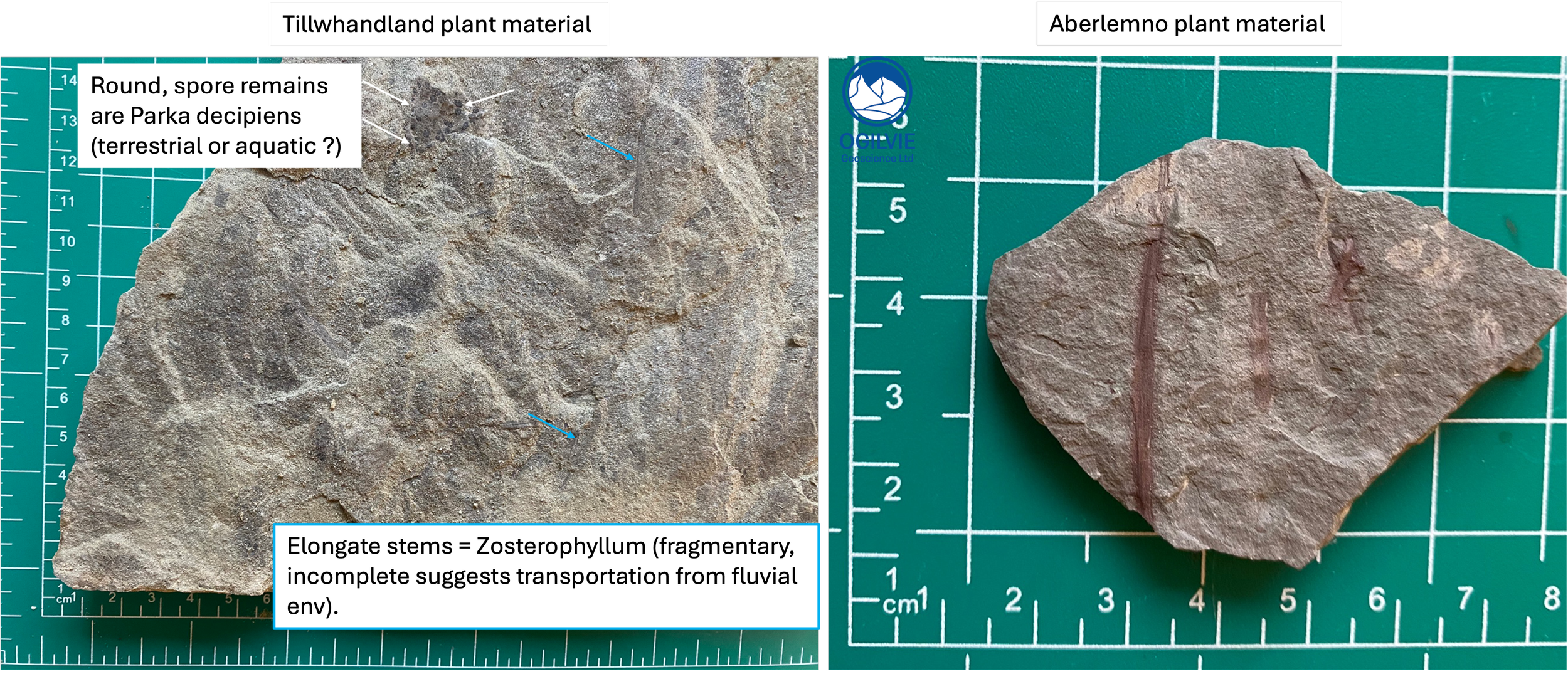
Different plant material collected in laminate rocks in Tillywhandland Quarry and Aberlemno Quarry
Trewin, N.H., Davidson, R.G. 1996. An Early Devonian lake and its associated biota in the Midland Valley of Scotland. Transactions of the Royal Society of Edinburgh: Earth Sciences, 86, 233-246.
Article focusing on value of spoil heap geology from Bob Davidson: https://www.earthheritage.org.uk/wp/wp-content/uploads/EH-64-final_web.pdf