

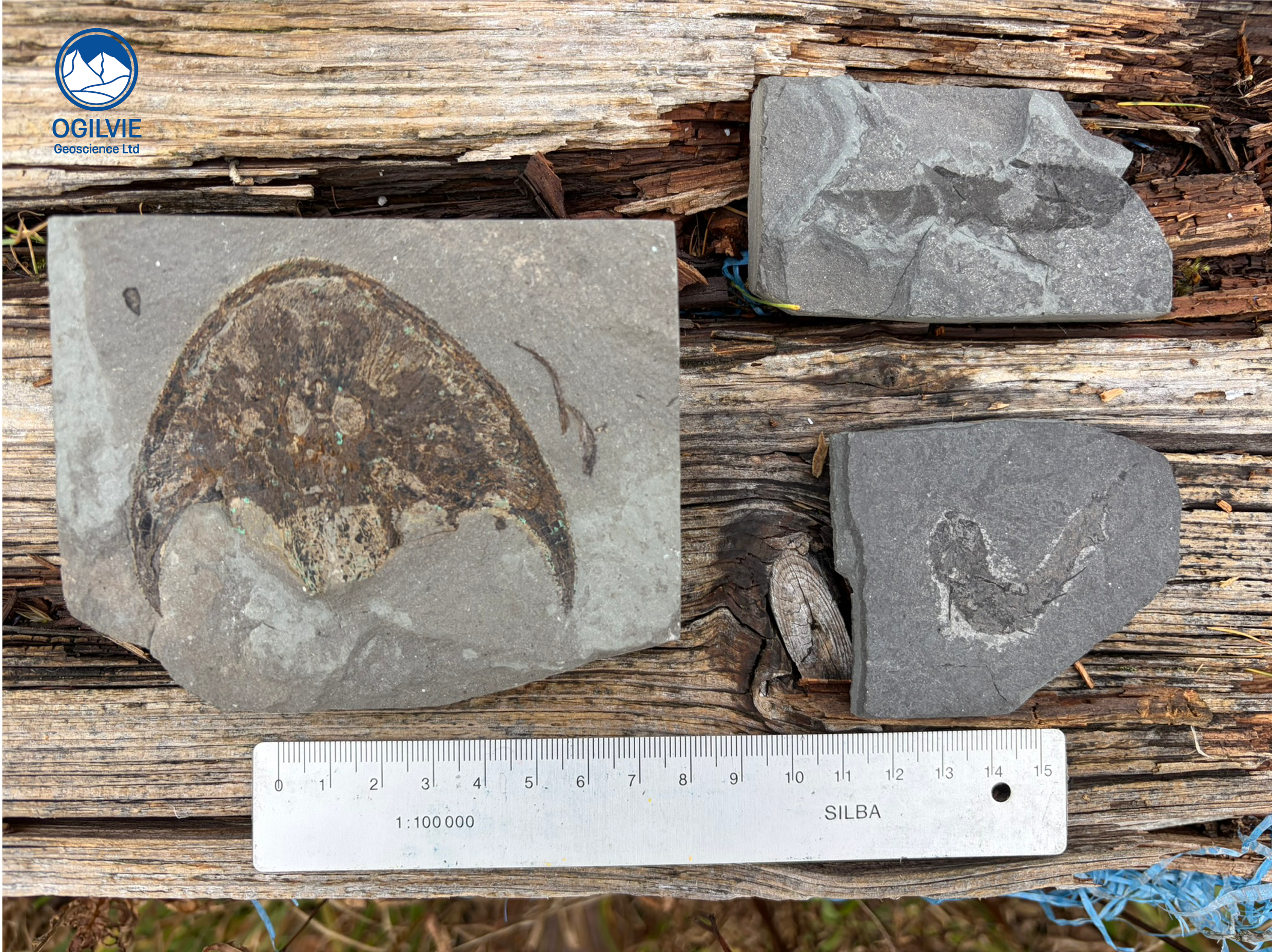
Fossil fish from the collection of Bob Davidson MBE - collected from this area over the years
Fish moving about in a lake about 410 million years ago
These fossils are some of the best specimens that have been found in this area in rocks from the Lower Devonian Period. They are from the collection of Bob Davidson MBE who was kind enough to show me around this area, just west (off the M90) of the city of Dundee.
Where is Balruddery ?
Have a look at the map below - it’s just outside Dundee off the M90 on the direction from Dundee to Perth. You can park just past the farm field gate next to the foundations of an unfinished building (Lat 56.485017, Long -3.12558.1).
There’s 3 known quarries (not working anymore) and extensive exposures of sedimentary rocks along the stream and also on the left hand side of the path when walking between quarries (#2 is marked on the map).
Permission is needed from the landowner to visit this site.
What do the fish beds look like ?
Since Bob’s last visit a fish bed laminite (a fine grained rock often formed in low oxygen water or quiet environments such as a lake) had been dug out - maybe by students ! We didn’t hammer any of the in-situ rocks but did try to open some of the loose pieces around it. Many of the pieces that you see above the bed (with hammer) are cemented by the mineral calcite.
Once you’ve got permission, only use hammer loose material, not in-situ rocks !
OK but theres more to the Geology than Fish ?
Yes, for sure - the 3 quarries provide cliff like sections through the laminites and also sandstones and volcanic rocks - that would otherwise not be exposed if they were not quarried. Actually thats not entirely true as there’s also rock exposures along the main stream and also small cliffs in between the quarries that would have been exposed before quarrying.
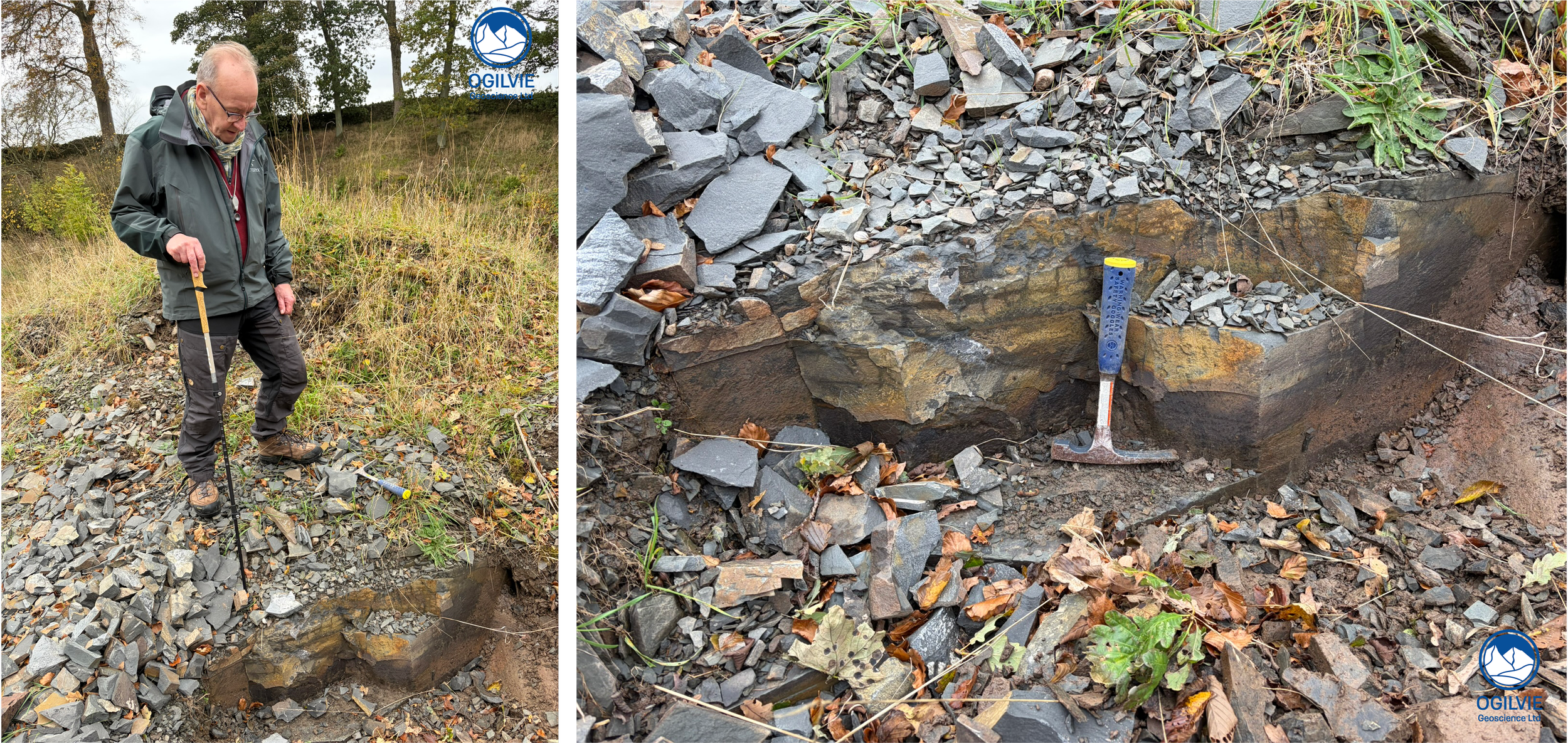
Bob Davidson MBE looking down at a newly exposed section of the fish beds at Quarry 3. Close up of the fish bed laminates surrounded by pieces of calcite cemented laminate.
How did the fish remains get preserved all this time ?
The fish remains such as those of Acanthodian (top right on fossil fish images) were protected from decaying as the water environment was lacking in oxygen (anoxic). This stopped any predators from eating up the remains and the remains decaying.
Also, the remains were effectively locked in by the precipitation of calcite cement - we can see this as white streaks in the broken grey coloured rocks scattered around the fish bed. In other fish localities in Scotland, the remains can be found within concretions which have calcite rims - these function in the same protective way as above.
Work done by Bob and team shows that most fish remains have been found below the bentonite layers - another means of protecting the remains.
Volcanic activity
The present is the key to the past ! When we come across evidence of (in this case) volcanoes being active during the Lower Devonian, we can visualise how things must have looked by looking at present day volcanic activity. This is all around us on the internet and on news reporting of common eruptions in islands like Iceland.
And it was common during the Lower Devonian in Scotland !
https://www.ogilviegeoscience.com/blog/zeolites-in-lava-crawton-aberdeenshire
At quarry 2, Bob and others have picked out thin (about 1 cm thick) beds of what has been analysed in detail as volcanic in origin. This beige/buff coloured (around a cm thick) band is rich in clay and has likely formed by the decay of volcanic material called a bentonite. There is a similar bentonite in the laminates in the back quarry at Tillywhandland (near Forfar).
Another piece of volcanic history is shown below, found at the boundary of the sandstones and laminates in quarry 3 - possibly a volcanic bomb. Whether we’d call it a volcanic bomb or not, it has a lot of holes that were probably formed by trapped volcanic gases. These holes got filled by minerals (often from the zeolite family) and were then plucked out by the forces of nature over many milions of years.
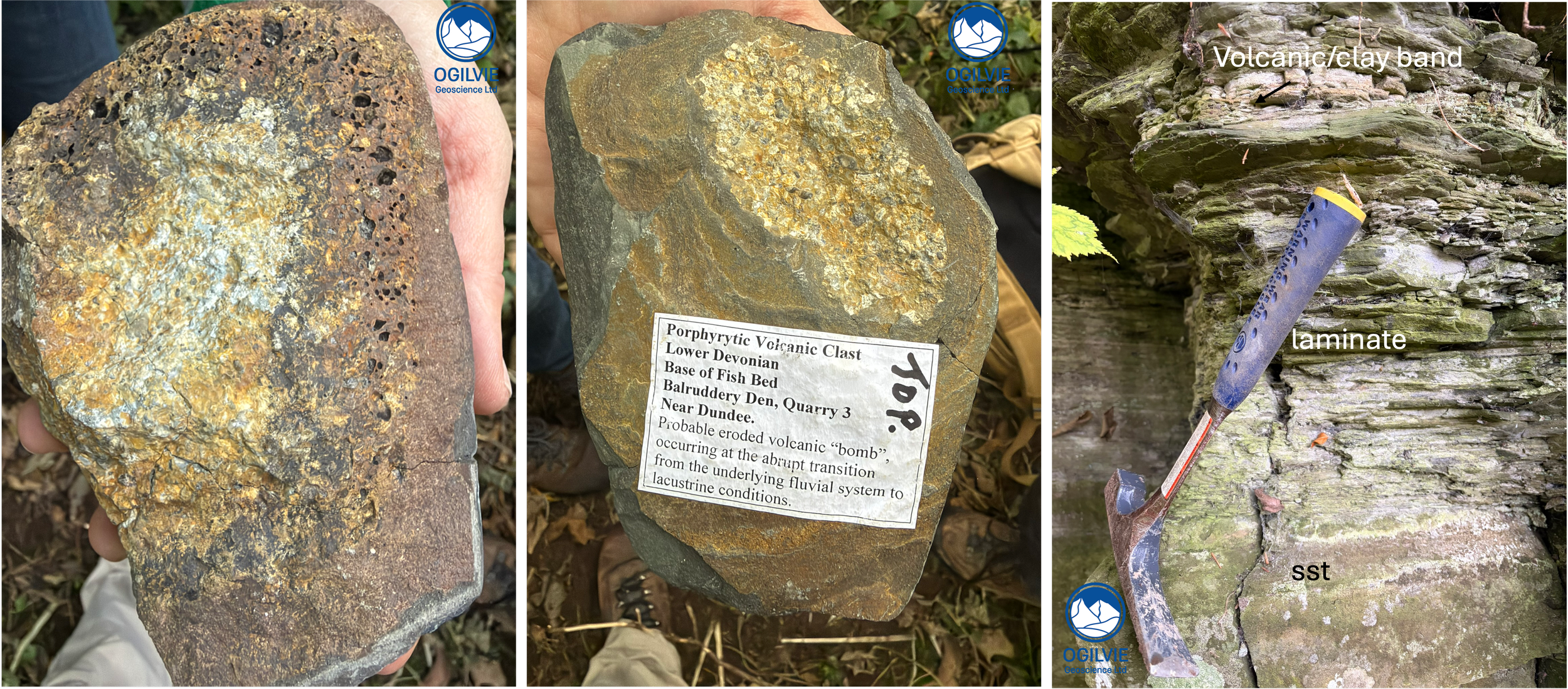
Volcanic activity at Balruddery !
The clast on the left and middle has been noted as a volcanic bomb. The thin beige coloured layer on the light is likely a bentonite - a weathered, clay rich volcanic layer
Alternating sandstones and laminites
The exposures en route from quarry 2 to quarry 1 are worth a look (on your left hand side). Thick sandstone beds are interbedded with finer sandstones and laminites (below left). It looks like the sandstones have less rock fractures than the laminates - a perfect example of mechanical stratigraphy where you often find more fractures in thinner beds. This type of stratigraphy (in this case alternating sandstones and laminates) and mechanical stratigraphy is similar to that found on the wall of Aberlemno Quarry near Forfar
https://www.ogilviegeoscience.com/blog/lake-forfar-and-its-devonian-age-fish
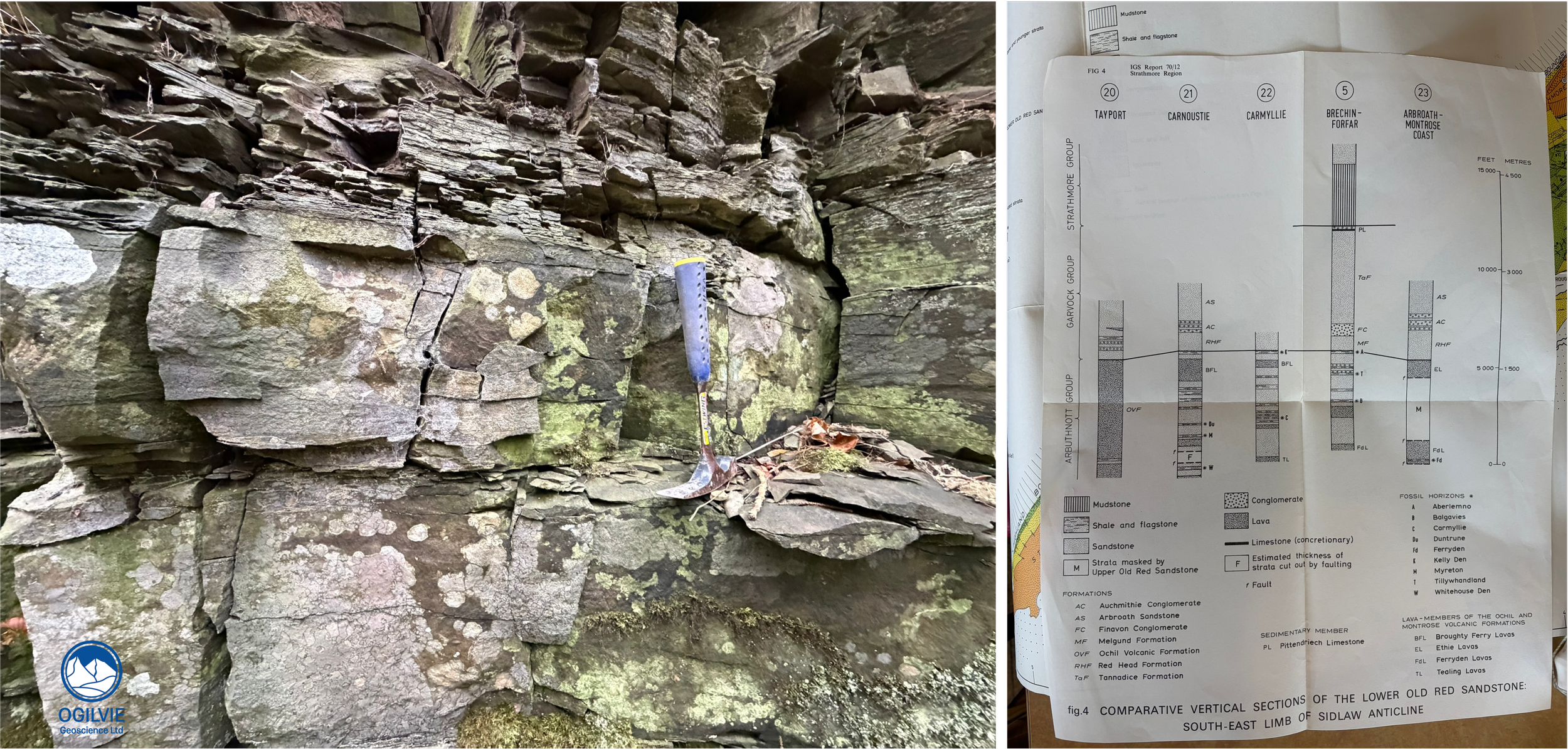
A bit more on..the stratigraphy
These rocks belong to the Dundee Flagstone Formation which sits within the Arbuthnott Group (log above right).
This Lower Devonian stratigraphy is closest to W on the Carnoustie log (Whitehall) and you’ll see that these rocks are older than the rocks found at Tillywhandland (T) and Aberlemno (A) quarries - on the brechin Forfar log. There is some variation on the stacking of the various lithologies along the section from quarry 3 to quarry 1. At quarry 1, the fish beds are overlain by sandstone beds, whereas there is not top sandstone present at quarry 1, where the sandstone overlain by laminite section is capped by a green shale. Also the volcanic beds appear to be localised to quarry 2 although this needs a further look.
The contacts between the different rock types is quite sharp here suggesting that things (environments of deposition etc) changed relatively quickly.
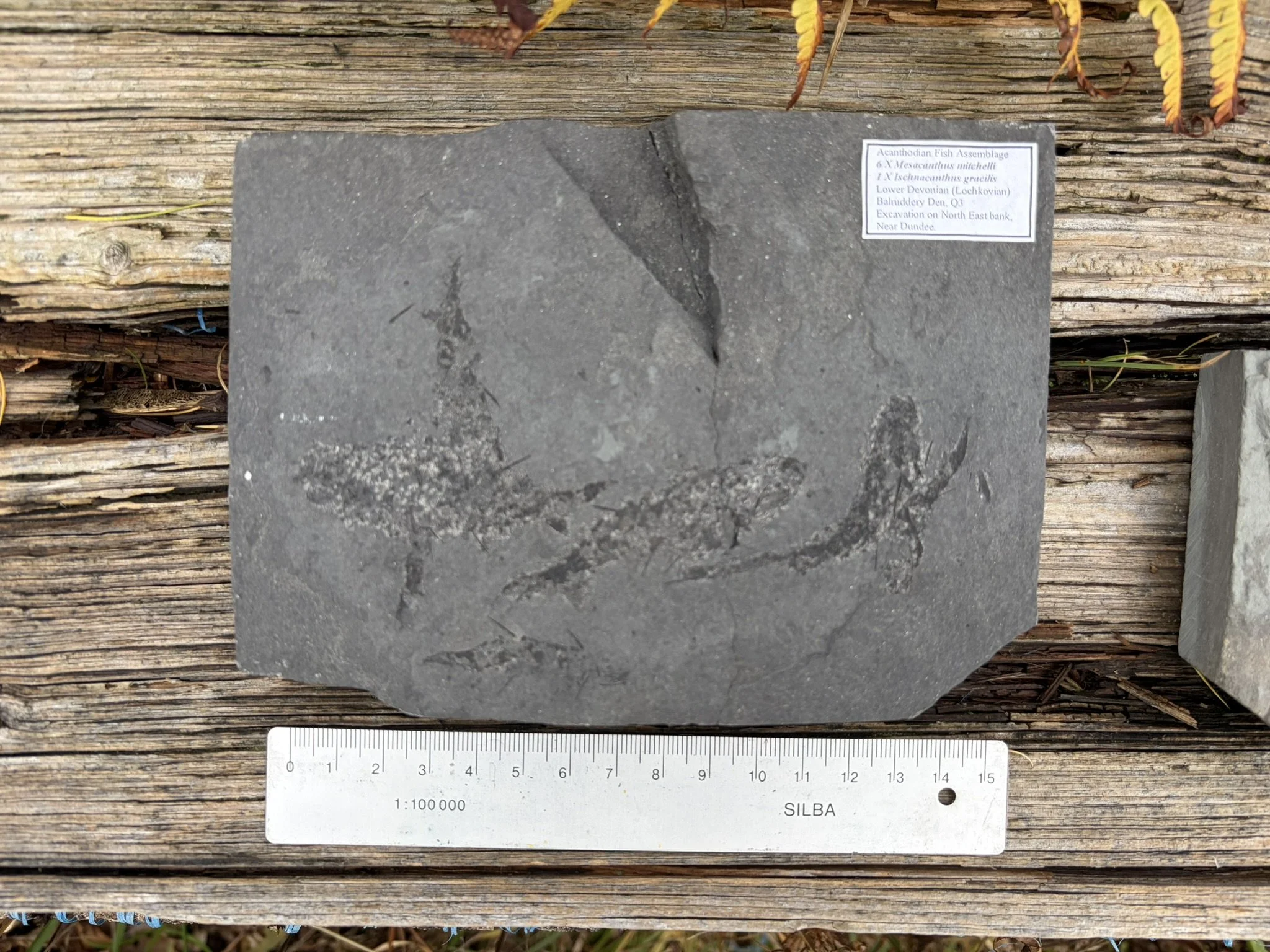
Several fish together (collection of Bob Davidson MBE) from Balruddery