
Low Angle Normal Faults
Why write about them ?
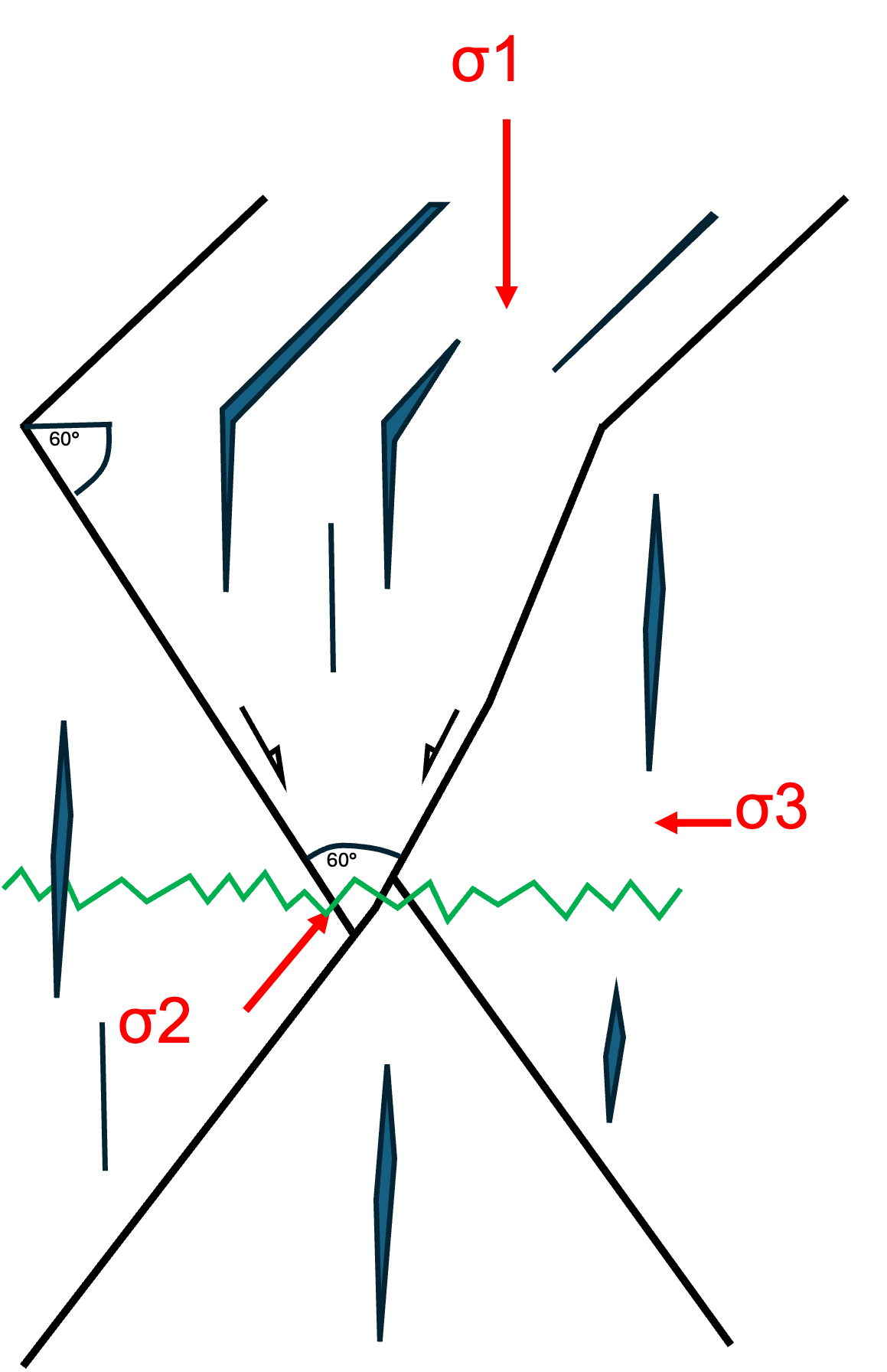
Anderson’s (1951) model for a conjugate pair of normal faults. It assumes that the surface of the Earth is not confined and not acted upon by shear stresses, that the rocks are homogenous and there is Coloumb behavior. Joints in blue and stylolites in green.
Because Anderson’s model predicts that normal faults tend to form with a dip of around 60 degrees. In fact we can use a 60-60 rule for normal fault pairs - both faults will dip at 60 degs and the and are separated from each by 60 degs. Such fault pairs are called conjugate faults (opposite)….
So, when normal faults are found with dips significantly less than 60 degrees (maybe 20-30 degrees), we are dealing with low angle faults and we have to explain why they are now dipping at a lower angle than when they formed.
Low angle faults are mechanically unfavourable but they often achieve the amounts of extension estimated in extensional environments such as the North Sea and in the Basin & Range Province, U.S.
But the traditional normal fault/graben model only provides a small amount of extension and in certain areas, low angle faults are needed to account for the calculated extension. There are other areas where steep faults have not been rotated - which may be due to rapid sedimentation (e.g., NW shelf Australia).
On the right, you’ll notice that one of the faults is older than the other i.e., the one that dips from right to left hand sides. We know this because it has been offset by the other fault that dips from bottom left to top right. Therefore, these are not true conjugate faults as don’t form at the same time. But we can generally call these conjugate faults.
Rotation
A common explanation is that the once high angle (60 degree dip) fault has been later rotated to a lower angle - these types of faults are very common in extensional basins such as the North Sea. Often, a series of low angle faults get rotated to higher angle by rotation along a master fault which flattens along a weka detachment zone. The beginning of the master fault has a curved or listric shape.
The rotation occurs along a listric normal fault in the upper crust, flattening along a weak detachment surface (or fault) at or near the brittle/ductile transition.
The rough sketch below shows a series of blocks bounded by normal faults that sole out on a detachment surface provided by a master fault. These blocks have become rotated on this surface - so faults that started off at around 60 degrees are now much lower angle faults. This type of movement is often called soft or ductile rotation (Fossen, 2016). The detachment surface can also be a weak layer such as one made of salt or mudstone.
Rock type
It’s interesting how the small structure (likely a fault) below takes on a more gentle dip as it leaves the limestone beds and enters the (dark grey) shales. Clearly, the geomechanical properties of the shales (shear strength) are quite different to the limestone - which impacts the dip angle at which the fault. When can say that the fault is refracted through the different rock types. This impact of rock type upon structural (geological) development is called mechanical stratigraphy. Another example of mechanical stratigraphy here are the higher amounts of extensional fractures (or joints) in the limestones than in the shales. Shales tend to deform in a more ductile manner than limestones when subject to the same stresses.
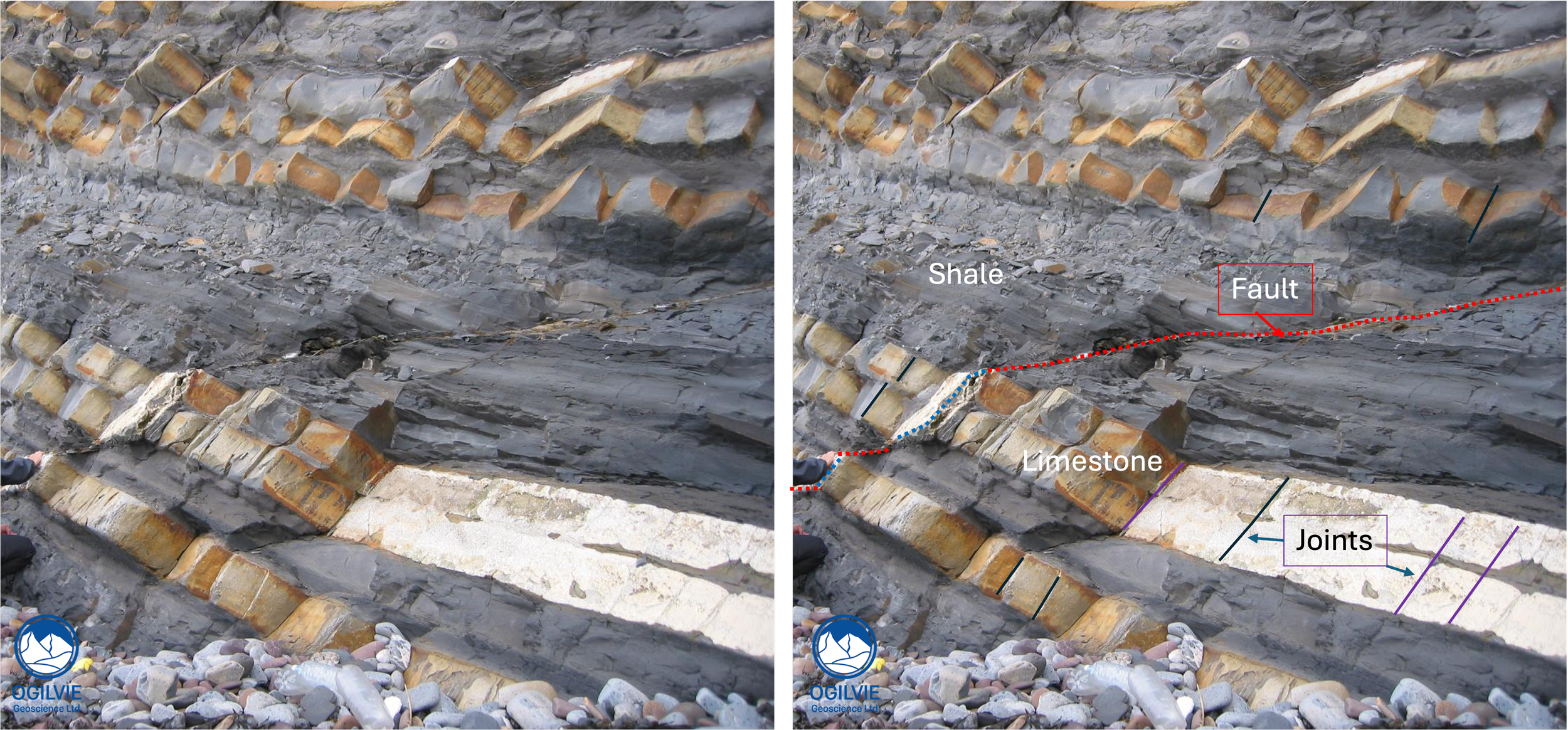
Fault refraction through limestones and shales on Jurassic age outcrops along the shores of the Bristol channel at Kilve, Somerset. Low angle part of fault through the shales shown by dotted red line and higher angle component by dashed blue line through limestones.
Stress
Low angle faults may form directly at high pore pressures - likely deep within the Earth’s crust. What happens is that increasing pore pressure acts to lower the effective stress which can activate low angle faults.
Pre-existing anisotropies
It is possible for normal faults to form directly along an existing weak feature such as bedding, foliation or perhaps a weak layer made up of salt or mud. Donath (1961) managed to produce shear fractures at very low angles to σ1 in anisotropic rock.