
Jointing in quartz-dolerite, Gloom Hill, Dollar
Where is this ?
It’s a disused a quarry in Dollar Glen, on route to Castle Campbell at the back of the town of Dollar in Clackmannanshire. I found this little gem on the Geosites from the Scottish Geology Trust.
https://geosites.scottishgeologytrust.org/geosite/180
There is a free car park just off the road to your right as you leave the town. From the parking, walk up onto the main road and there is a sharp right turn up a path towards the quarry. It’s just a short walk from the car park.
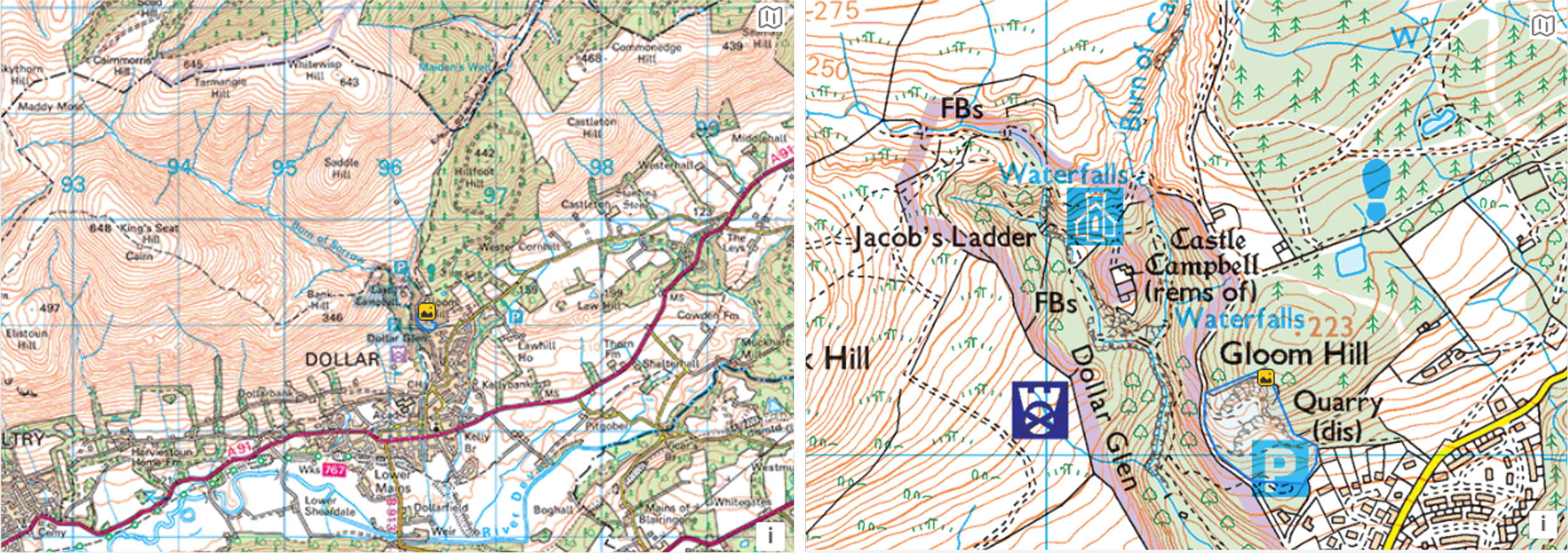
Geosites map showing location of Gloom Hill quarry (orange box with black symbol) outside of town of Dollar and (right) close up of the Parking (P) next to the Quarry at Gloom Hill
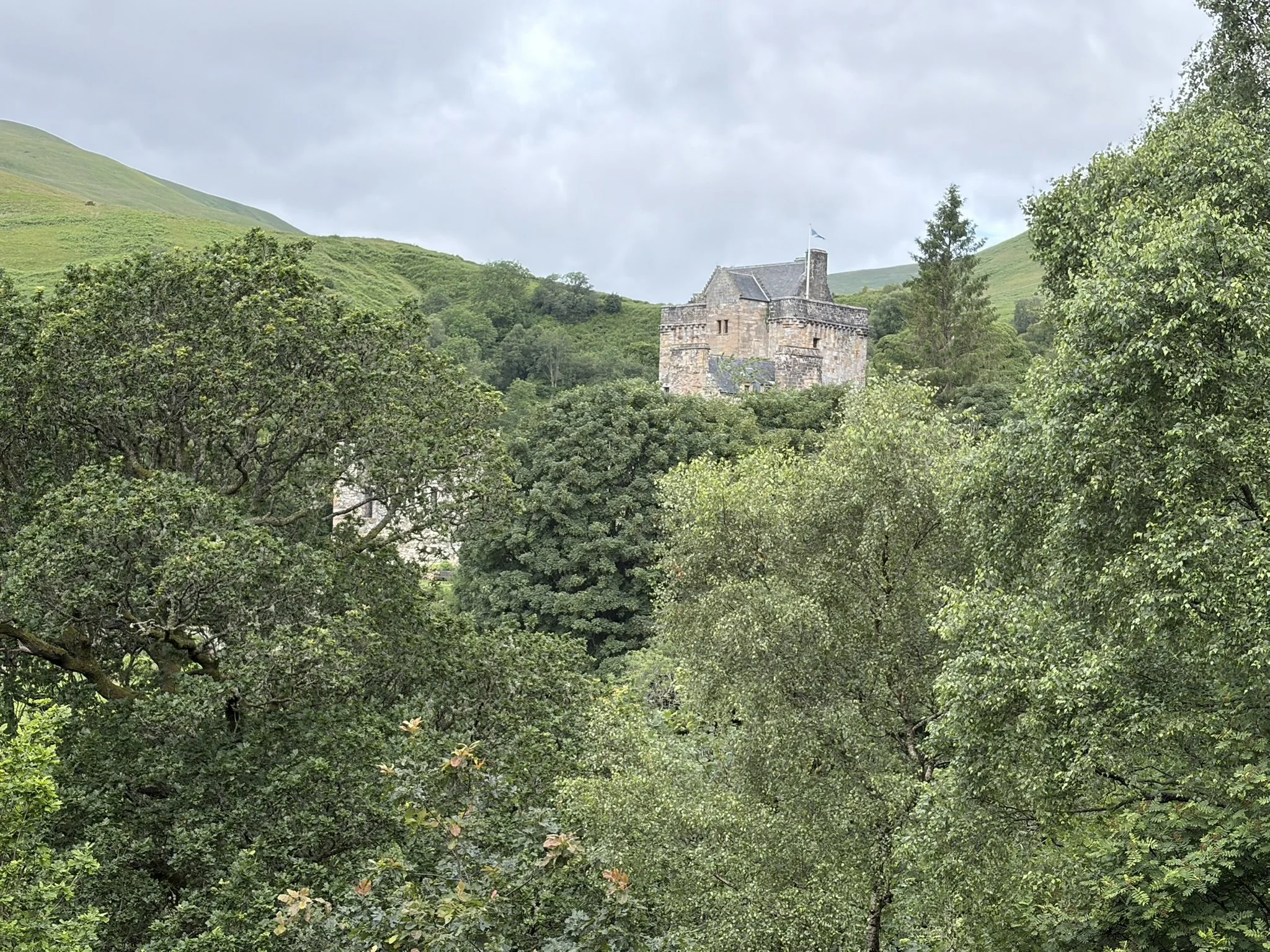
View of Castle Campbell from the road a few minutes from the car park
The Geology of Gloom Hill Quarry
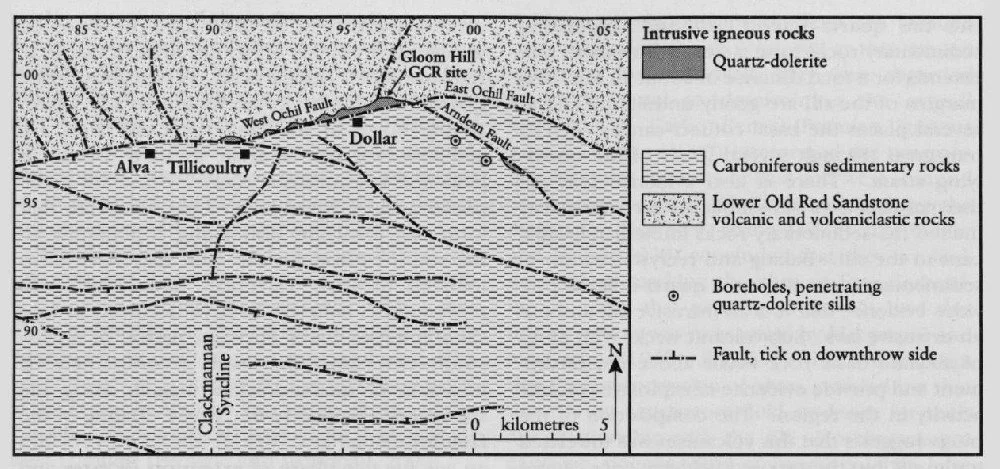
Map of the area (from Geosites and Rippon et al . 1996)
An igneous rock known as quartz dolerite has been quarried here - most likely the broken rocks were used for constructing roads. This greyish/greenish coloured rock forms when magma cools and crystallises at depth. The crystals are therefore coarser (larger) than lavas such as basalt as have had more time to form. Quartz dolerite differs from dolerite as has an excess of the mineral quartz which gives it a lighter appearance than a dolerite.
A rift valley was developing in Scotland during the Carboniferous and Permian periods (360 - 260 million years ago). The E-W trending Ochil Fault was one of the main faults associated with the rifting event. The quartz dolerite is a body of igneous rock - before it solidified, the liquid magma rose up through this major fault. It is part of a suite of sills and dykes emplaced during the Late Carboniferous - Permian periods.
Therefore the Ochill Fault is older than the quartz dolerite rocks that we see here in the quarry. It has likely been initiated during the Devonian but main movement was in the Late Carboniferous.
The quarry face provides a fairly linear exposure of quartz dolerite from left to right (hand side). There are many blocks on the quarry floor which can be studied for various geological features described below - so it’s best not to get too close to the main quarry face in case a new block starts moving down towards you !
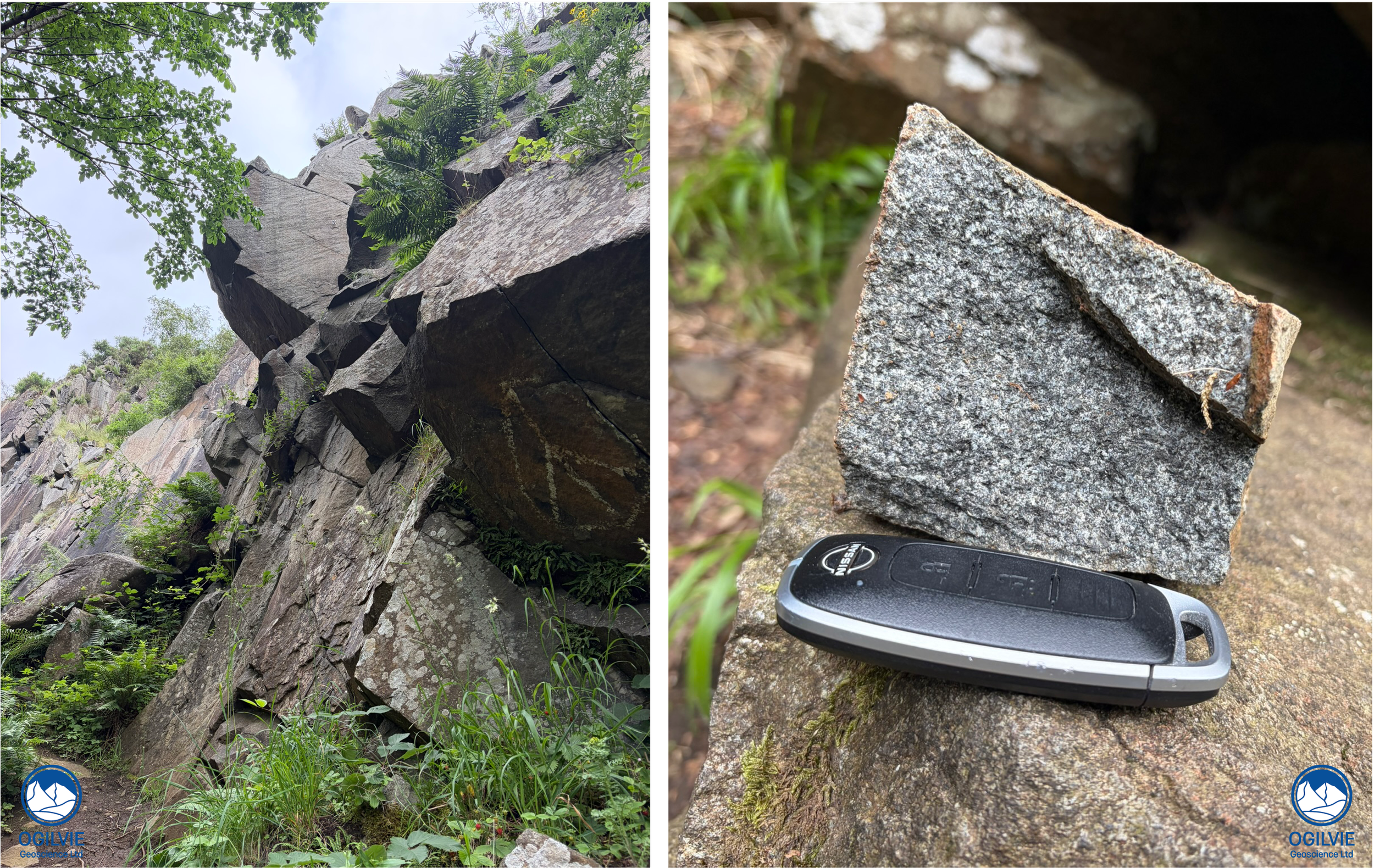
Looking along the wall of the quarry at the numerous joint faces and a rare piece of fresh quartz dolerite
Different types of joints
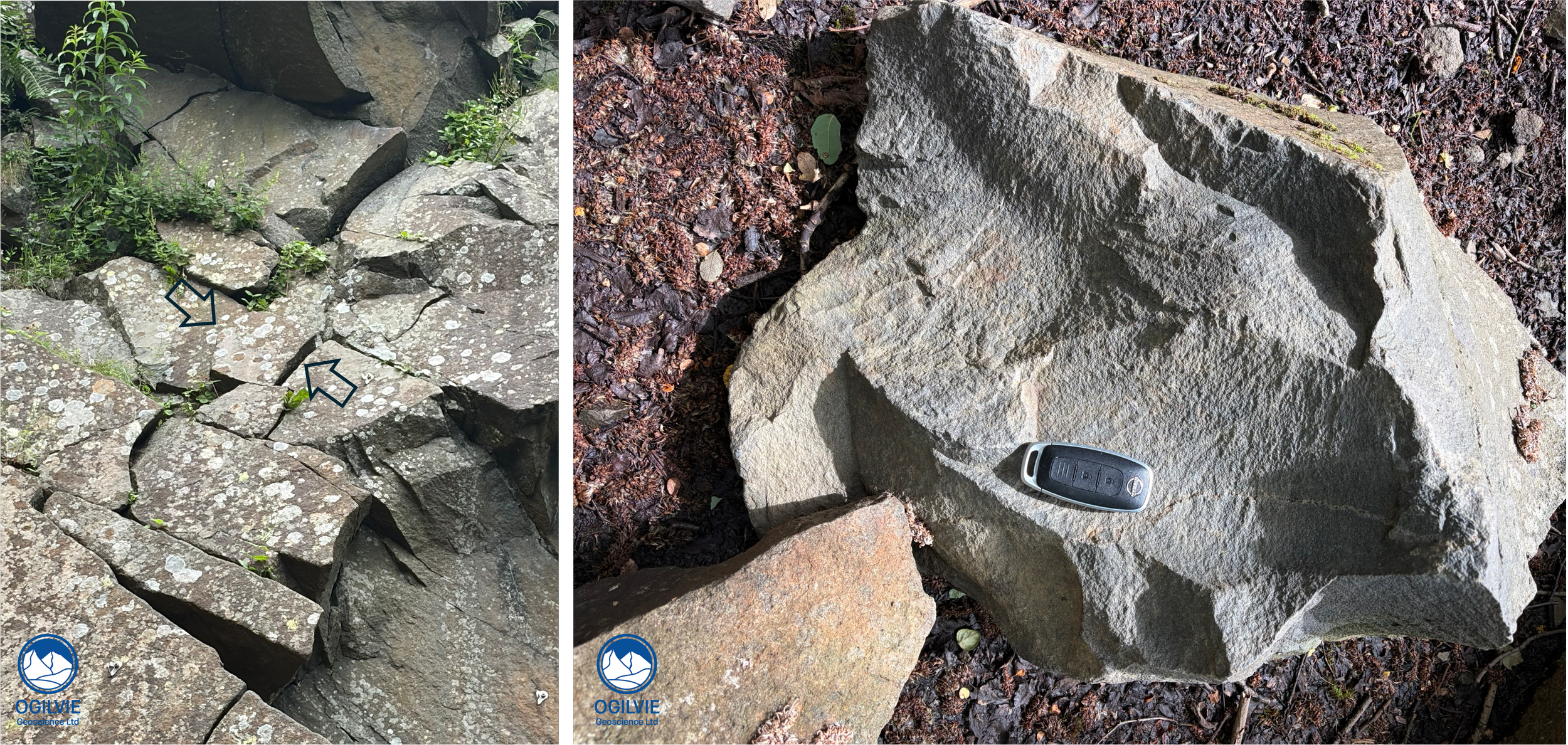
Arrows point to flat lying polygonal columns and (right) conchoidal fractures with curved surfaces in quartz-dolerite
Theres lots of different types of joints on display in the dolerite, which are also called extensional fractures. Our first example are conchoidal fractures which are common in quite fine grained and brittle igneous rocks, and have a characteristic curved surface. Many of the joints have formed due to unroofing - or removal of the rocks above the dolerite. This creates a stress release and often leads to the formation of joints.
There are also flat lying cooling joints (known as polygonal columns) formed as a result of the molten magma cooling then contracting after it has moved into place along the Ochill fault. These structures often have 5 or six edges, the best vertical examples in Scotland being found on the Isle of Staffa on Scotland’s west coast.
Flat lying columns (found here in the quarry face) are less common than vertical ones but are often found along the edges of igneous intrusions when the cooling surface is vertical.
Other features found in the rocks on the quarry floor are plumose markings on joints which are fan-shaped markings that show the direction of joint propagation.
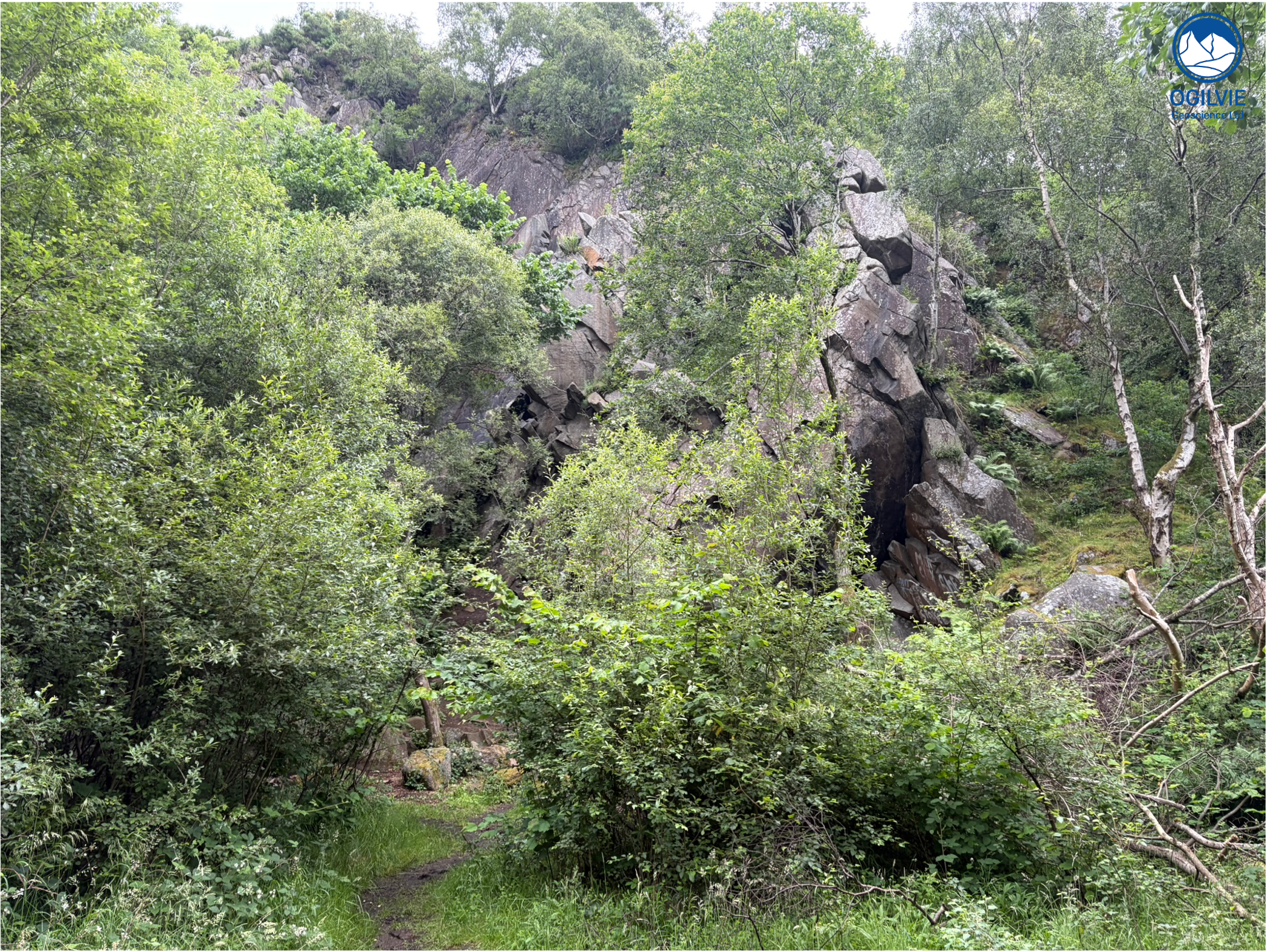
Approach to the quarry showing the main (only) quarry face of quartz dolerite