
Soft sediment faults & their folds in Hopeman Sandstone, Moray
What are thrust faults ?
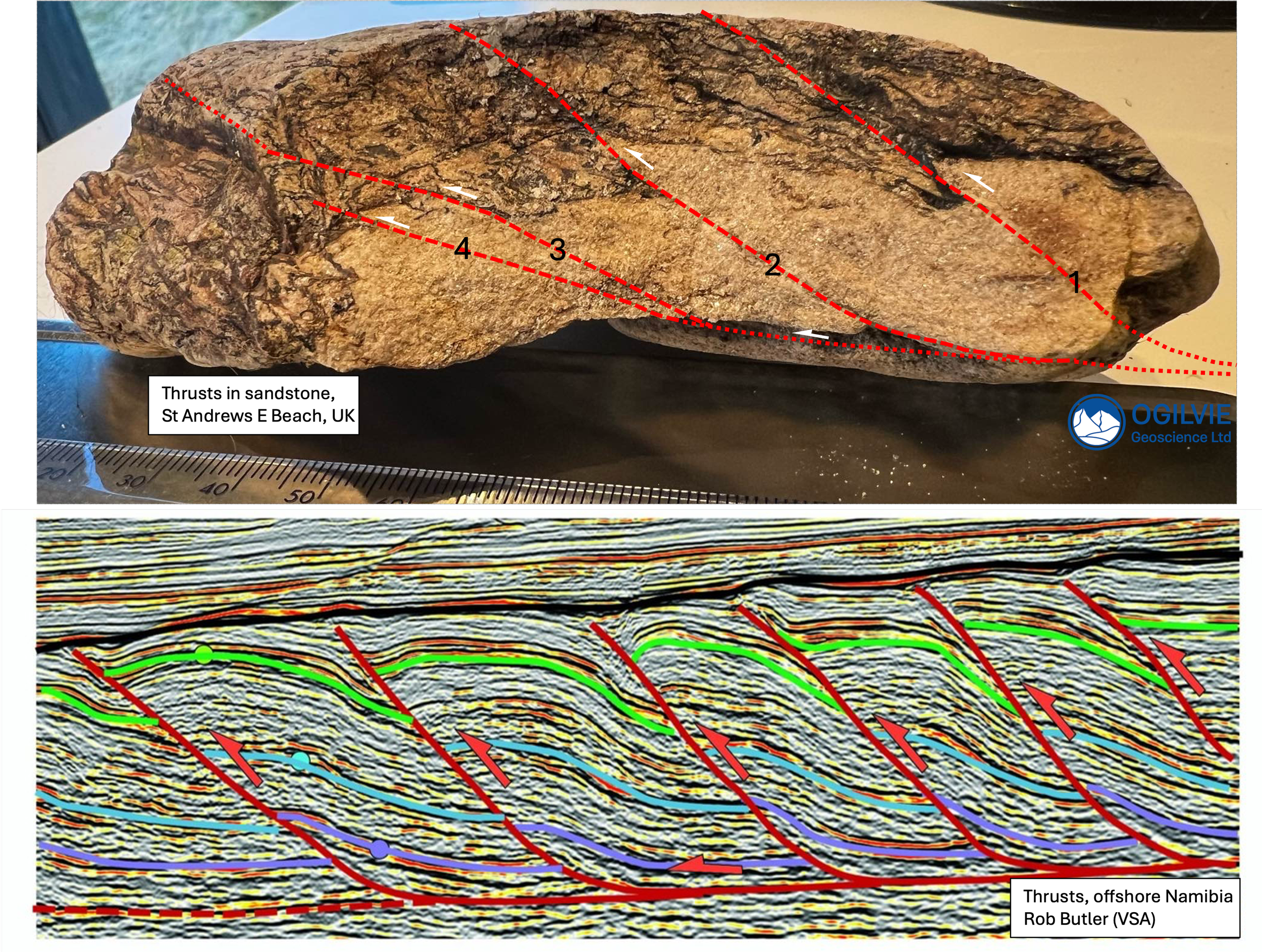
Thrust faults and their folds in a hand sample of sandstone from St Andrews Kinkell Braes area (from Craig Lindsay of CSS) . Lower - thrust stack interpreted on seismic data from offshore Namibia (Rob Butler, VSA).
Reverse faults which have a dip less than about 45 degrees. As is the case with reverse faults, thrust faults accommodate shortening as a result of compression (a type of tectonic activity). In turn, the resulting folds are important in resource geology as form hydrocarbon traps in many compressional settings.
A thrust will put older over younger strata resulting to create a repetition of strata. They tend to join up at depth, and “sole out’ on a more gently dipping horizontal floor or sole thrust. They occur at all scales from hand specimen size to much larger seismic data scale (opposite). The oldest fault is on the right of the hand specimen of sandstone - labelled 1. Sometimes the oldest fault has the steepest dip (as shown by no. 1 opposite and can be seen also on the seismic section).
The 6 thrust faults lined up on the hand specimen and on seismic section (opposite) make up what we can call a thrust system. These are located underneath an unconformity surface (black line).
There is likely some vertical exaggeration on this seismic section, hence the dips are not true dips.
Thrust faults in the Hopeman Sandstone
The photo below shows up to 3 faults arranged in a thrust system like those from Namibia and St Andrew’s area above. These were first presented on a sketch (by way of publication) by Douglas Peacock of the Geological Survey in 1966 - noted as drag folds, accompanied by shearing and imbrication. He noted that the beds have locally moved to the south.
First glance would suggest that these [label 1] have formed by tectonic movements but it is likely that these have formed as a result of soft-sediment deformation, possibly the escape of air - as they occur below a truncation surface at the same level as an upward directed and quite common air escape structure [label 2].
I haven’t over-interpreted this but it looks like the faults could be joined up at depth (base of the outcrop) onto a sole thrust. It also looks like a small thrust may be present at label 2, which is maybe superseded by more funnel shaped structure.
I took this photo during the Prof Ken Glennie memorial conference in May 2026 but need to go back for a more detailed look !
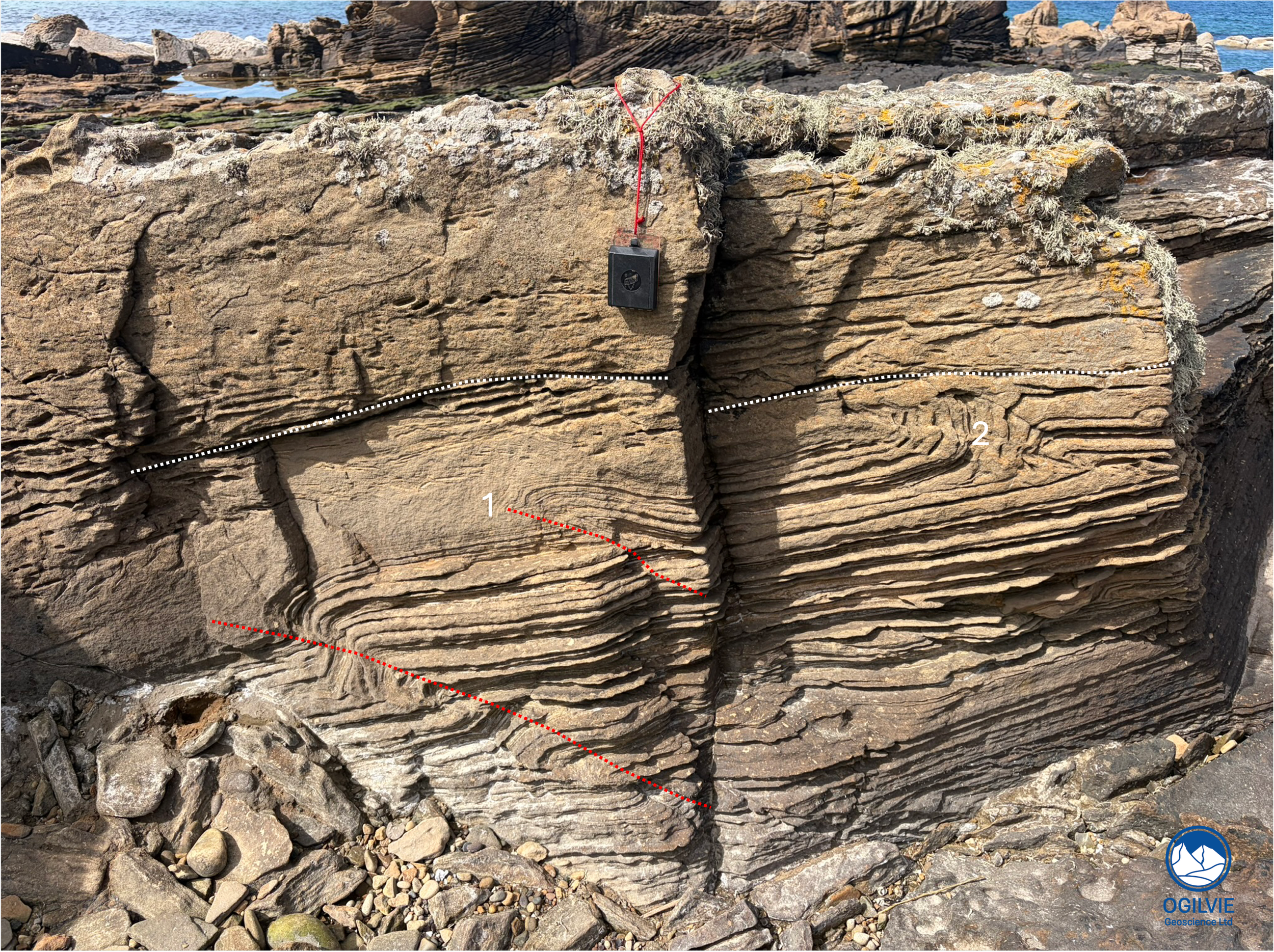
Thrust faults [1] on the side of a small outcrop of the Hopeman Sandstone - note the related upward directed air escape structure at [2]. Location is just to the west of Clashach Cove.